
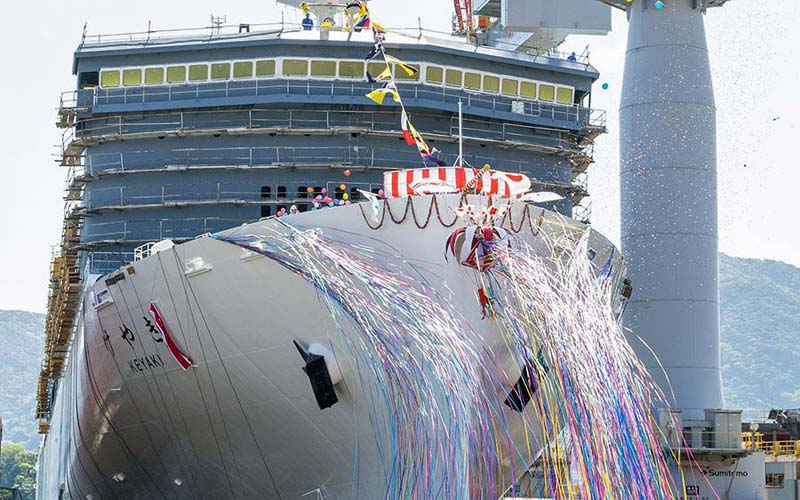
Mitsubishi Shipbuilding, a Mitsubishi Heavy Industries (MHI) Group company, has held a christening and launch ceremony for the first of two large car ferries ordered by Shinnihonkai Ferry Co and Japan Railway Construction, Transport and Technology Agency (JRTT).
The launch took place at the Enoura plant of MHI’s Shimonoseki Shipyard and Machinery Works. The new ferry will serve on a shipping route between the city of Otaru in Hokkaido and Maizuru in Kyoto Prefecture.
This is the first ferry in Japan to adopt MHI’s latest energy-saving hull form, including a Katana Bow and buttock-flow stern hull with ducktail. The stern is designed to protrude like a duck’s tail, while the hull is optimised for reduced water resistance. Propulsion resistance is suppressed by an energy-saving roll-damping system combining an anti-rolling tank and fin stabilisers. Together these innovations enable a 5% savings in energy consumption and emissions compared to earlier vessels.
The vessel was named Keyaki, the Japanese word for a species of native Zelkova trees. Handover is scheduled for December 2025 following completion of outfitting work and sea trials. The Keyaki is the ninth ferry built by Mitsubishi Shipbuilding for Shinnihonkai Ferry.
According to MHI, Japan is currently undergoing a modal shift to sea transport in an effort to mitigate environmental impact by reducing CO2 emissions and to compensate for truck driver shortages arising from workstyle reforms. This shift has brought ferry transport into sharp relief.
The Keyaki is 199m long, of 14,300gt and is designed for a service speed of 28.3 knots. It has capacity for 286 passengers, plus 150 trucks and 30 cars.
Image: Christening and Launch Ceremony of ‘Keyaki’ (source: Mitsubishi Shipbuilding)