
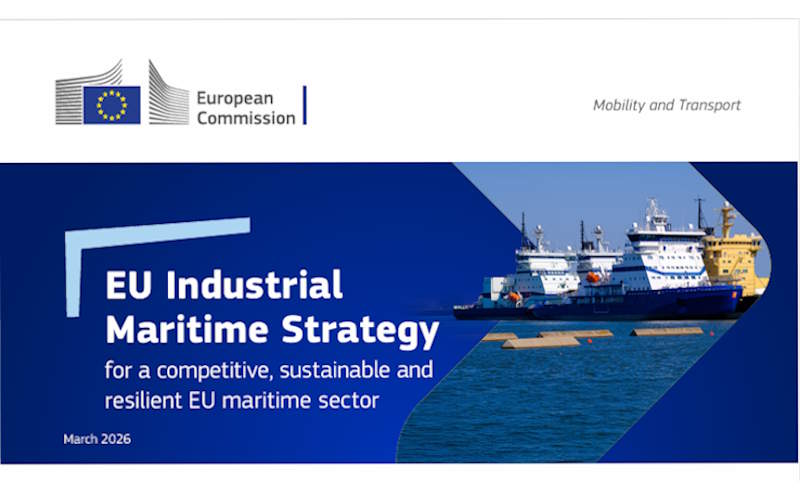
The World Shipping Council (WSC) and Methane Abatement in Maritime Innovation Initiative (MAMII) have both reacted to the EU Ports Strategy and Maritime Industrial Strategies.
WSC welcomes support for maritime decarbonisation in both the EU Ports Strategy and the Maritime Industrial Strategy.
WSC President & CEO Joe Kramek said:“Europe’s commitment to a global measure through the International Maritime Organization is essential, and we support action to review EU measures to avoid double payment.”
WSC said the Port Strategy’s focus on renewable fuel availability, a multi-fuel approach and accelerated deployment of onshore power is a positive step.
Kramek added: “Liner shipping has invested more than €125bn in over 1,100 dual-fuel vessels delivered or on order. Port infrastructure must match fleet investment with fuel supply and electrification.”
WSC also welcomed recognition in the Industrial Maritime Strategy of the need to simplify requirements under EU ETS and FuelEU Maritime, but at the same time, it said the strategies do not go far enough on trade simplification to support the EU competitiveness agenda.
Kramek said: “In a true single market, moving goods by ship within Europe should be as seamless as moving them by truck. Reducing intra-EU customs barriers and administrative friction would be one of the fastest ways to strengthen Europe’s competitiveness, and we would welcome clearer action in this area.”
Meanwhile, although MAMII has welcomed the Industrial Maritime Strategy as a major step forward for shipping decarbonisation, it warns that methane emissions remain a critical blind spot that must be addressed if the strategy is to deliver its full climate impact.
Panos Mitrou, MAMII Chair, said: “The Strategy supports biomethane as a fuel pathway, including by calling for the removal of barriers to cross-border biomethane trade. However, methane emissions from ships themselves remain under-recognised and are treated implicitly through fuel transition language and alternative fuel policy, rather than as a standalone climate risk requiring targeted action. Technologies to accurately measure and remove methane emissions are proven and ready. The barrier to their implementation is policy, funding and regulatory clarity. With targeted support, these technologies could be scaled rapidly, delivering one of the fastest and most effective pathways to cut maritime emissions. The opportunity is real, but it will not be realised without explicit prioritisation.”