
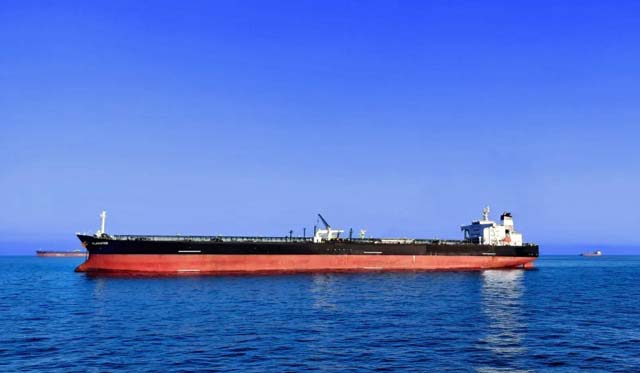
Lloyd’s Register, Samsung Heavy Industries (SHI) and MISC via its subsidiary, AET, have signed a Memorandum of Understanding (MoU) for the development and construction of two very large crude carriers (VLCCs) which can be operated on zero-emission fuel.
The three companies, all founding members of The Castor Initiative, are taking the lead to encourage the use of green ammonia as propulsion fuel, with the first of these dual-fuel tankers entering into service in late 2025 and the second in early 2026. The Castor Initiative, a multinational coalition committed to make zero-emission in shipping a reality, includes MISC Berhad (MISC), Lloyd’s Register (LR), Samsung Heavy Industries (SHI), MAN Energy Solutions (MAN), the Maritime and Port Authority of Singapore (MPA), Yara International ASA (Yara) and Jurong Port (JP).
Following signing of the MoU, The Castor Initiative members will focus on identifying green shipping corridors to facilitate the bunkering of these zero-emission VLCCs.
Motivated by the partners’ shared belief that the maritime industry needs leadership and greater collaboration if shipping is to meet the IMO’s GHG ambitions, The Castor Initiative members will be looking into the establishment of approved training syllabus for seafarers in at least two maritime training institutions. It is crucial to ensure that the latest training and education is provided to the crew to enable the smooth operations of the zero-emission VLCCs.
Lloyd’s Register Group CEO Nick Brown said: “In 2018, Lloyd’s Register made it clear that the IMO’s 2050 emission target would require deep-sea zero-emission vessels to be entering service before 2030, and that zero-emission operation would need to become the default for most deep-sea ships delivered after 2030. Since then, we’ve seen the IPCC report of 2021 issue ‘a code red for humanity, and many call for net-zero emissions by 2050. Today’s announcement fires the starting gun for deep-sea shipping to transition to a fuel which contains no carbon molecules, and Lloyd’s Register is delighted to be supporting this transition.”
SHI President and CEO J.T. Jung said: “We are very delighted to be a part of this inspiring, industry-leading collaboration paving the pathway to zero-emission shipping. The Castor Initiative members have already made impressive progress in making deep-sea zero-carbon vessels in the last few years, and we believe this new development of zero-carbon VLCCs will be accelerating the progress of The Castor Initiative and greatly help bring sooner energy transition in the shipping industry. As a shipbuilder trusted by our valued partners, SHI will strive to contribute to the realisation of a sustainable shipping industry by putting our best efforts into this new collaboration.”
MISC President and Group CEO, Datuk Yee Yang Chien, said: “The signing of today’s MoU is the beginning of many more forward moves that will come from The Castor Initiative, to accomplish our GHG ambitions jointly, ahead of 2050. The efforts of our collaboration have brought us to this historic moment where we will soon see the delivery of the world’s first two zero-emission VLCCs, which will be owned and operated by AET. Getting these vessels on water is not the only focus, there is the long game of ensuring the reskilling of talent and the availability of bunkering facilities which are key to the sustainable operations of these two new vessels. The MoU signed today would not be possible if not for the shared commitment, goals, and ambition we have, as The Castor Initiative. My appreciation to all members of The Castor Initiative for being part of this journey and I am confident that we will continue to make bold strides together, to unlock the possibilities that lay ahead.”