
Water treatment specialist Bio-UV Group has introduced a new Compliancy and Performance (C&P) agreement solution for shipmanagers looking to ensure their Bio-Sea ballast water treatment systems retain regulatory compliance and maintain operational standards.
The new service agreement aims to address the challenges ship operators face in maintaining regulatory compliance amid increasingly stringent ballast water management inspection regimes and operational demands on ship crews. With over 30% of vessels failing D-2 compliance tests despite having installed type-approved systems, the C&P agreement provides a framework for proactive system maintenance and support.
Jean Philippe Picard de Muller, Head of Bio-UV Group Service Division, said: “Too many shipowners still see ballast water treatment systems as ‘install-and-forget’ solutions. In reality, ballast water treatment systems require continuous maintenance and well-trained crews to operate them effectively. Neglecting these essentials not only threatens compliance but also risks damaging marine ecosystems.”
Bio-UV Group understands that key maintenance procedures, such as air and water filter cleaning, UV lamp replacement, and sensor calibration, are often overlooked. Even fully operational systems can fail if crew members are not properly trained to manage daily checks or identify irregularities such as pressure drops or unusual noises.
Picard de Muller continued: “Routine checks are essential. Crews need to verify valves are in the correct position, and any condensation is drained. Our Compliancy and Performance Agreement is the first line of defence against compliance failure by ensuring ship operators receive the technical support and spare parts they need to keep their Bio-Sea systems performing efficiently, in top condition.”
The C&P agreement includes an annual onboard visit by Bio-UV Group technicians, who perform a thorough inspection and calibration of critical system components, including sensors and flow meters. The agreement covers crew demonstrations and basic onboard training to reinforce operational confidence. Ship operators can benefit from special pricing on essential spare parts and additional services.
Picard de Muller said: “This helps operators stockpile critical components and avoids costly delays linked to supply chain uncertainties or third-party dependencies. There is also an option for system maintenance during dry-dock periods allowing owners to align system upgrades with planned vessel downtime.”
For a fixed yearly fee per vessel, shipowners receive proactive annual onboard visits, calibration of critical sensors, verification of system functions, inventory checks, and crew training. IMO data reveals that 77% of shipowners report operational issues with their BWMS, citing crew knowledge gaps as a leading cause, while Port State Control officers are increasingly questioning crews on system operation and compliance procedures.
Charlène Ceresola, BWT Project Manager, Bio-UV Group, said: “Shipowners do need to prioritise continuous training, covering not only system operation but also troubleshooting and emergency procedures.”
Indeed, port authorities have increased inspections to enforce the D-2 discharge standard, with reports indicating more than 30% of ships failing D-2 compliance inspections, often due to operational errors such as mixing treated and untreated water, regrowth of organisms, and inconsistent system use. Regulators are also tightening administrative requirements. Nearly 60% of ballast water-related deficiencies stem from poor record-keeping.
In February 2025, updated IMO guidelines BWM.2/Circ.80/Rev.1 entered into force providing clarity with examples of entries and mandating more detailed records of all ballasting and de-ballasting operations, including system treatment status, actions in challenging water conditions and any non-compliant discharges. Adding to the complexity, some systems installed years ago now face sustainability challenges.
Ceresola said: “A well-maintained record book is as important as a well-maintained system. Shipowners must audit documentation regularly to avoid detentions. When manufacturers exit the market, shipowners risk being left without spare parts, software updates, or technical support. This jeopardises compliance even if the system was type-approved at the time of installation.”
Bio-UV Group advises shipowners to stockpile essential spare parts, establish support agreements with OEM, and consider system updates or upgrades during dry-dock periods.
Ceresola concluded: “Non-compliance can lead to ship detentions, substantial fines, and reputational damage. Meeting ballast water regulations is not just about ticking boxes. Shipowners must act now to ensure their systems are reliable, their crews are trained, and their documentation is complete.”
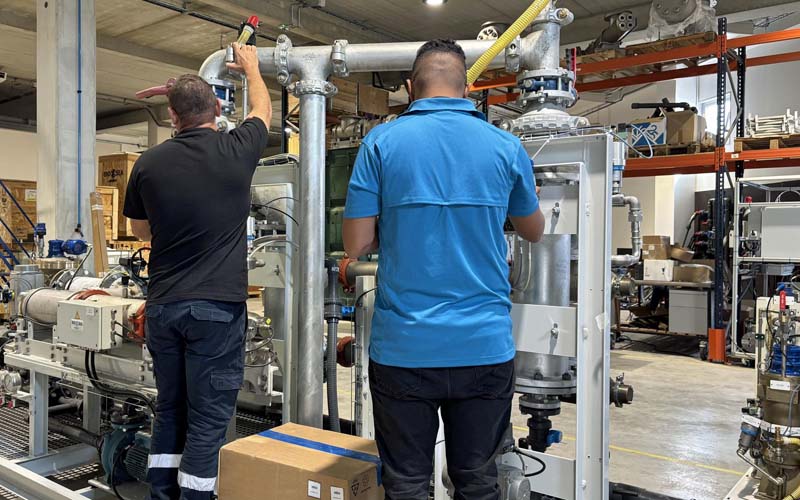
Image: If a crew cannot demonstrate competence, even a fully functional system may not pass inspection (source: Bio-UV Group)