
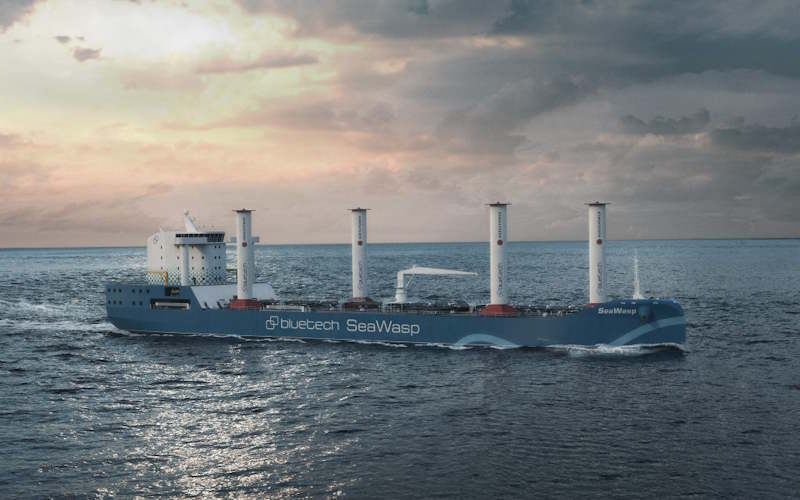
As part of shipowner International Seaways (INSW)’s long-term sustainability strategy, Norsepower and Bluetech Ship Design have partnered to explore how much extra savings and emission reductions, in conjunction with Norsepower rotor sails, could provide to INSW’s SeaWasp tanker concept.
When applied to newbuild vessels that are optimised for wind propulsion use, the results have so far demonstrated confirmation of the technology’s potential with total savings of up to 876 kW of propulsion power on one representative INSW MR tanker route from San Francisco to South Korea – equating to around 597.2t of fuel per year, and the additional fuel savings attributable to the design contributing up to 13.5% of those savings in certain conditions.
NYSE-listed INSW embarked on the project with a clear goal: to assess whether wind propulsion could deliver meaningful benefits for the tankers of the future.
Michael LaGrassa, INSW Director of Performance and New Construction, said: “We focused on more than just energy savings and emissions reduction — our goal was a concept design that works in the real-world conditions of the MR trade. That meant ensuring reasonable build costs, equivalent cargo capacity, and a design fit for purpose. Our approach was to test a wide range of scenarios across the MR trade, rather than rely on selectively favourable assumptions.“
With Norsepower rotor sails at its core, Bluetech’s design modifications were shown to extract significantly greater forward thrust. In one of the simulations, on a San Francisco–South Korea route, two 35m x 5m Norsepower rotor sails delivered an average propulsion power of 876 kW — equivalent to 597.2t/yr of fuel.
Bluetech Director of Energy Savings Solutions, Sam Robin, said: “We set out to develop a ship that is entirely WASP-optimised while maintaining every essential operational feature and meeting trade-specific restrictions. The result is a vessel design that significantly enhances propulsion without compromising practicality.”
The SeaWasp project investigated performance across less favourable wind conditions. On the South Korea–Singapore route, for example, savings of 185.9t/yr of fuel were still achievable. This balanced approach was important to ensure the commercial projections of the project remained realistic.
Bluetech’s naval architects incorporated a range of innovations to maximise efficiency.
Robin added: “The BT50 design is itself approximately 12% more efficient than the typical tanker performance profiles in the sample fleet. Our design modifications enhance that efficiency even further.”
Above the waterline, the design includes an aero superstructure and semi-enclosed mooring stations to reduce wind disturbance. Beneath the waterline, a new fin system named ‘blueSURF’ was shown by CFD analysis to significantly increase power saving potential.
Juha Hanhinen, Bluetech Head of Hydrodynamics, said: “We were surprised by how significant the fin effect was — it creates a powerful case for combining hydrodynamic improvements with wind propulsion.”
Norsepower supported comparative studies of different Norsepower rotor sail configurations.
Severi Sarsila, Sales Engineer, Norsepower, said: “In the simulations related to this specific case, four 24m x 4m sails were marginally better, but overall, the two 35m x 5m sails offered the highest potential savings at lower cost.”
The collaboration has highlighted how carefully optimised vessel design, paired with proven wind-assisted propulsion, can unlock new levels of efficiency.
Robin said: “The SeaWasp concept shows that wind propulsion is not just an add-on — it can be central to the way ships of the future are designed.”
Ville Paakkari, Head of R&D, Norsepower, said: “SeaWasp is an inspiring example of how naval architecture and advanced wind propulsion can be combined to unlock the full potential of our technology. By optimising the design around the Norsepower rotor sail, Bluetech and INSW have shown how newbuild projects can deliver both impressive fuel savings and practical fleet operations. Going forward, we will be able to show even bigger savings and emission reductions with the Norsepower Sentient Control, our data-driven control system”
William Nugent, CTOl and Chief Sustainability Officer, INSW concluded: “The future certainly looks brighter for our next generation of tanker shipping. Creative problem-solving following a thorough design process will be one of the keys to success.”
Image: SeaWasp tanker concept (source: Norsepower)