
A Norwegian consortium has been formed to develop a new solution for decarbonising maritime transport by capturing and storing CO2 from LNG-fuelled solid oxide fuel cell (SOFC) power trains.
The project, known as LNGameChanger, is led by maritime technology supplier HAV Group, plus coastal cruise operator Havila Voyages, natural gas company Molgas Norway (formerly Gasnor), and research institution Sintef.
Gunnar Larsen, CEO HAV Group, said: “The LNGameChanger project aims to create the basis of a new product in form of a low-or zero-emission solution for the maritime industry, strongly positioned for a growing LNG market and infrastructure with superior efficiency to alternative solutions. If this objective is achieved, LNG can become not only a transitional fuel, but a permanently viable option in low-emission maritime transport, alongside for example hydrogen.”
Given a successful outcome of LNGameChanger, project owner HAV Group has a clear ambition to further mature the solution towards commercialization and include it in the company’s growing portfolio of low-and zero-emission solutions to the maritime sector.
The LNGameChanger project’s primary objective is to design an innovative, decarbonised maritime LNG-fuelled power train combining SOFCs and high-efficiency onboard CO2 liquefaction and storage, resulting in a CO2-equivalent intensity between the 2045 and 2050 emission limits.
Secondary objectives are to confirm energy efficiency and emission targets for the SOFC power train with CO2 capture in stand-alone mode. The project also aims to establish a user case with a vessel design and relevant operational profile to extract load profile characteristics and perform voyage simulations for the vessel in study. The user case may be Havila Voyages’ four coastal cruise ships. The performance of the SOFC power train integrated with the onboard CO2 capture and storage (OCCS) will be determined. It will also evaluate overall space and weight requirements and adaptability for marine applications.
Havila Voyages’ four coastal cruise ships all use LNG as fuel in combination with battery power. The company takes great interest in the LNGameChanger project.
Bent Martini, CEO Havila Voyages, said: “We have clear ambitions to move towards carbon neutrality and eventually zero emissions, and that can be done with our current fleet. This project is of great interest for us as our main power source today is LNG. We are eagerly awaiting the results and possibilities that lay ahead. To be able to meet future requirements and reach the goals for a greener future, we cannot lock ourselves in one direction. We have to investigate the possibilities available to find the best solution, both for the environment and from a business perspective.”
In addition to the required onboard processes, LNGameChanger will address the infrastructure needs related to decentralised CO2 collection and transport in port. This includes the potential for combining this logistically with LNG distribution.
Anders Torp Rød, MD Molgas Norway, said: “This technology could provide a clear pathway for large scale, low emission solution that leverages well known and robust supply chain of energy to hard to abate sectors. Molgas Energy supports developments that aims to reduce emissions based on available technology and product availability.”
While LNG only accounts for about 4% of the fuel supply for international shipping, the number of LNG-powered ships is predicted to increase substantially as global shipping is embarking on a fuel technology transition. According to DNV’s Alternative Fuels Insights (AFI) platform, the number of LNG-fuelled ships in operation doubled between 2021 and 2024, with a record number of deliveries (169) in 2024. By the end of 2024, 641 LNG-powered ships were in operation. According to the orderbook, this number is expected to double by the end of the decade.
Larsen said: “It is also worth remembering that between 2024 and 2026, the EU Emissions Trading System (EU ETS) is gradually extended to include emissions in the maritime transport sector, and from 2025 the FuelEU Maritime regulation has entered into force. This gives extra incentives for the development and deployment of technologies for reducing or eliminating maritime CO2 emissions.”
The Norwegian Research Council has awarded LNGameChanger a grant of approximately NOK 5m over the project’s two-year duration, providing ground for research activities by Sintef. The project partners will all be actively involved in the project execution. For HAV Group, this includes involving technical experts for ship and systems integration, regulatory compliance and risk assessment as well as overall project management. The first step of the LNGameChanger project is to conduct necessary feasibility studies and simulations to define the readiness to take the decarbonised SOFC power train solution to a subsequent prototype demonstration level in a successor project.
David Berstad, researcher, Sintef, said: “We are excited to be a part of this project. Sintef is involved in a growing portfolio of projects that focus on different solutions for decarbonisation of the maritime industry. A low-to-zero-emission concept that combines an established maritime fuel with innovative CO2 capture technology is a promising solution that can be applied to many different vessel types.”
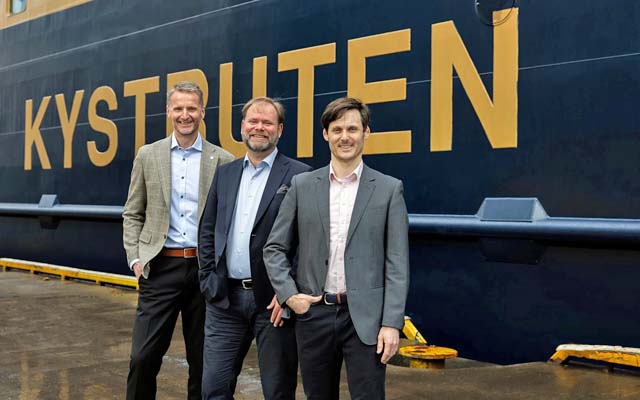
Image: Launch of LNGameChanger project (source HAV Group)