
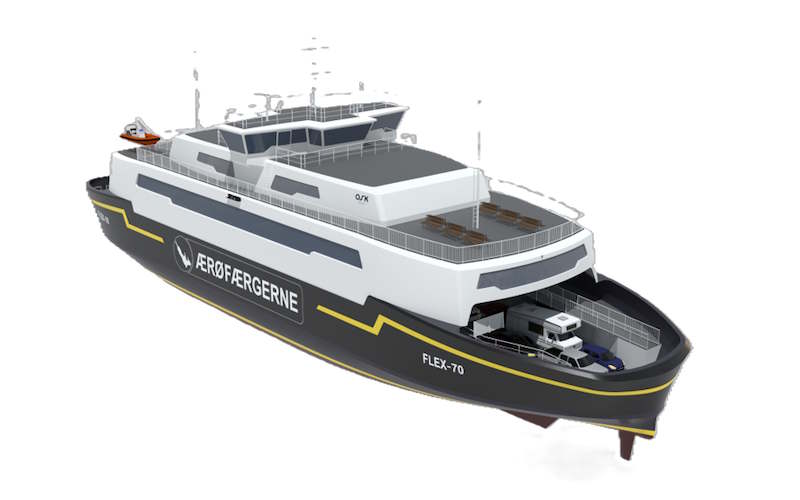
OSK Design, Samsø Municipality, Ærø Municipality and Bureau Veritas have received a regulatory clarification that OSK says can pave the way for a new generation of energy-efficient and emission-free ferries.
The Danish Maritime Authority informed the partners that the OSK LightCraft ferry design project can proceed according to the national regulations, as long as the ferries meet the required safety level. This is considred an important milestone for the development of the ferries of the future. The clarification opens up the possibility of using a design where low weight is actively used to reduce energy consumption, without compromising safety.
The OSK LightCraft concept has been developed by OSK Design in close collaboration with the municipal shipping companies Samsø Rederi and Ærøfærgerne and Bureau Veritas. A lighter aluminium hull can significantly reduce energy consumption compared to a traditional steel ferry design. The lower energy demand makes full electrification much more realistic and can thus lead to a significant reduction in CO2emissions.
The concept has been developed for Samsø Rederi’s route Hou–Sælvig and the Ærø ferries’ route between Ærøskøbing and Svendborg. In the long term, the design principles can be applied to similar domestic routes.
Following discussion between the project parties, the Danish Maritime Authority and the European Commission, the Danish Maritime Authority confirmed that the ships will not be covered by the EU Passenger Ships Directive, but can be approved under the national rules for smaller passenger ships engaged on national voyages. The requirements of the HSC Code can be used as an alternative solution to the general national requirements when it is documented through an individual risk assessment that the ferries achieve a corresponding level of safety.
The existing ferry on the Samsør Route emits about 7,200t of CO2 annually, while the two twin ferries on the Ærøruten route emit a total of about 7,800t of CO2 a year. The ambition is that electrification combined with the lower energy consumption can bring emissions from the ferry operation itself close to zero.
Kristian Carøe Lind, Chief Design Officer, OSK Design, said: “It is fantastic that we can now continue to work with the FlexFerries according to the OSK LightCraft principles. The idea is simple: We want to give the ferries the capacity the routes require, but build them significantly easier. We save more than 30% energy and thus significantly reduce the very high costs of charging infrastructure and the battery pack. Throughout the percent, OSK has been focused on optimising the municipalities’ expenses throughout the value chain from the electricity grid, the port and to the ferry.”
With clarification from the authorities, an important barrier has been removed. Now the work continues to find the financing so that the ambition of a new generation of energy-efficient and emission-free ferries can become a reality.
Image: OSK LightCraft ferry concept (source: OSK Design)