
Oslo is marking the 10th anniversary of its Climate Budget, said to be the first of its kind in the world and now adopted by cities worldwide.
Over the past decade, the Climate Budget has transformed ambitious climate targets into measurable outcomes. The Climate Budget is designed to embed climate targets directly into the city’s financial planning and decision-making framework, ensuring that emissions reductions are managed with the same rigour and accountability as fiscal objectives.
Mark Watts, Executive Director of C40 Cities, said: “We have already seen many individual ports innovating on clean shipping, from Shanghai to Los Angeles to Singapore. It is exciting to learn that Oslo is also amongst the greenest ports in the world – being the most advanced in technologies, particularly electrification.” Watts concluded.
Modelled on Oslo’s Climate Budget, all 94 C40 member cities are required to have a climate budget in place by 2030 as part of their membership commitments.
Watts continued: “It’s undeniable that Oslo is an absolute pioneer and leader in many areas, and it is also very good at sharing best practices. It has a responsibility to do so because Norway is a major oil and gas producer, whose national oil company continues to invest research and development funds in oil and gas. The science is clear. We need to phase out fossil fuels immediately. I think the city’s leadership is absolutely to be lauded – it is very, very real – but in the context of global climate justice, it is also what Norway should be doing.”
Daniel Boero Vargas, leader for Industry Decarbonisation, Cement and Concrete, World Economic Forum, said: “Oslo is a global leader when it comes to climate ambitions, and Port of Oslo is a catalyst for innovation and ideas. It has been interesting to learn how the port contributes to making the shipping sector greener by offering charging facilities alongside its wider work on emissions-free construction,” The recent World Economic Forum in Davos featured industrial decarbonisation prominently on the agenda.
Boero Vargas added: “The WEF’s Annual Meeting is an important arena for fostering collaboration and exchanging ideas. Transferring experience from one sector to another can drive innovation. I take with me the insight that environmental incentives at the port can be transferable to other industries. It was interesting to hear that the most environmentally friendly cruise ships in Port of Oslo pay less than those that pollute the most. Such environmental incentives could be applied to other sectors, such as some of the heavy-emitting industrial sectors covered by the First Movers Coalition.”
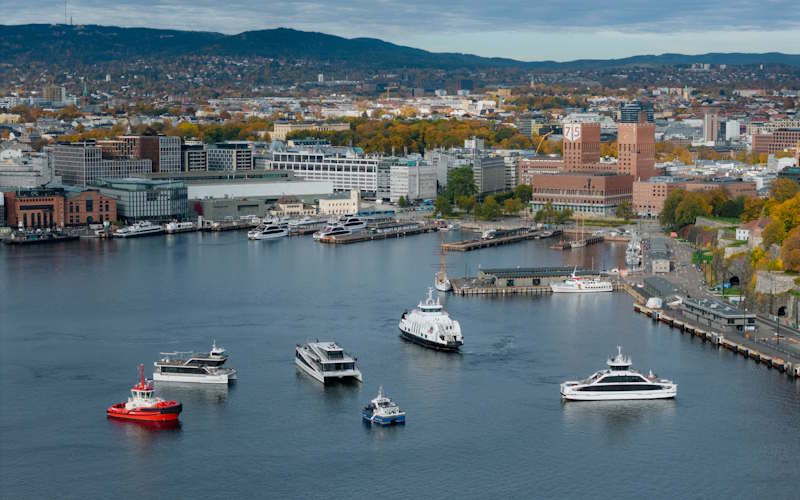
Port of Oslo Director and CEO Ingvar M. Mathisen concluded: “Port of Oslo’s vision is to be the world´s most effective and environmentally friendly city port. In all modesty, I think it’s fair to say that no other port can showcase the same results regarding electrification of the port sector as us. Furthermore, I don’t know of any other cities in the world with the same level of electrification of public transport on water as Oslo. Local ferries transport thousands of passengers emission-free every day and close to 4m passengers per year. Visionary and ambitious politicians have helped us set the course towards a zero-emissions future. Aligning with Oslo’s Climate Budget and setting clear goals for zero-emission operations, including the electrification of port equipment and the use of shore power for ships, has resulted in a 29% reduction in greenhouse gas emissions so far. Our target is 85% by 2030.”
Image: Electric vessels in Oslo port (credit: Nikolas Gogstad, Spoon/Port of Oslo)