
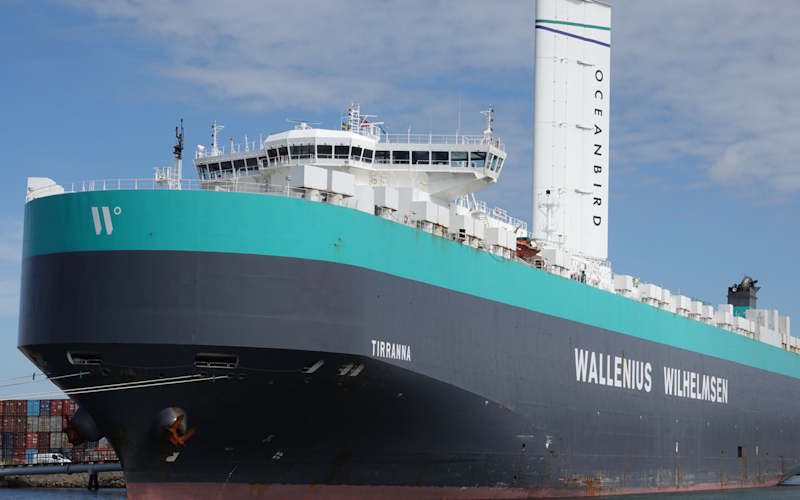
Wallenius Wilhelmsen has completed the installation of a wing sail on PCTC ‘Tirranna’, marking a new phase in testing wind-assisted propulsion in commercial operations.
The installation took place at Damen Shipyard in Rotterdam, followed by a harbour acceptance test and a sea acceptance test (SAT). The installation is a full-scale test designed to generate real-world insight into how the technology performs at sea. The aim is to build practical experience on board a ro-ro vessel and evaluate how wind propulsion can contribute to lowering emissions.
Lars Ekren, Senior Manager Newbuildings and Conversions, Wallenius Wilhelmsen, said: “Exploring wind-assisted propulsion builds on a long history of testing new solutions to improve energy efficiency in our fleet. This is a full-scale installation in commercial operation, giving us the opportunity to learn how this technology performs in practice. It’s an important step in evaluating how solutions like this can work alongside our existing efforts as part of a broader approach to reducing emissions.”
The project is part of a broader approach to decarbonisation, where multiple technologies and measures are explored in parallel.
Jørgen Westrum Thorsen, VP Orcelle Accelerator, Wallenius Wilhelmsen, added: “This builds on our long history of testing innovative solutions to improve how we operate and reduce fuel consumption. It’s exciting that the wing sail is now onboard Tirranna. We look forward to testing the technology and seeing its impact first hand.”
The vessel will now enter normal operation while performance data is collected and evaluated. The installation onboard Tirranna follows land-based testing in Landskrona in Sweden. The installation on Tirranna marks a milestone in the Orcelle Horizon project, where 11 partners are working together. The partners are Wallenius Wilhelmsen, Oceanbird, Wallenius Marine, KTH Royal Institute of Technology, RISE Research Institutes of Sweden, Ghent University, StormGeo, Volvo Cars, Maritime CleanTech, The National Technical University of Athens and DNV. The project is funded by the European Union.
Image: Wallenius Wilhelmsen’s ‘Tirranna’ (credit: Wallenius Wilhelmsen / David Falk / Göteborgs Hamn)