
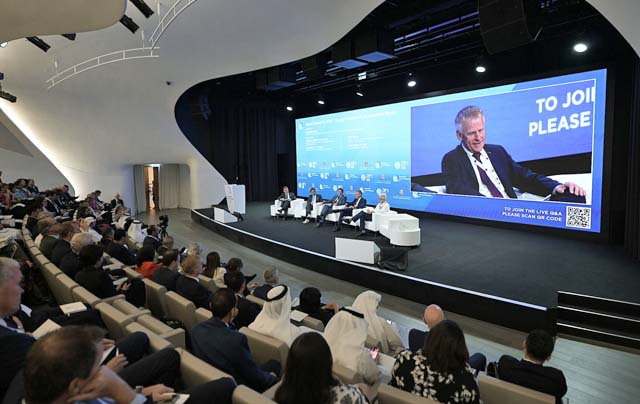
Jens Meier, president of International Association of Ports and Harbors (IAPH) and Hamburg Port Authority CEO, called on ports to actively collaborate with each other on knowledge sharing between themselves and the maritime community to accelerate decarbonisation.
At a recent summit during COP28, hosted by the UAE Minstry of Energy and Infrastructure, and coordinated by the International Chamber of Shipping (ICS), in partnership with Emirates Shipping Association, Meier cited capacity building of ports and their people as well as the development of safety and readiness level tools by IAPH climate and energy technical committee port colleagues as examples of such collaboration.
Meier said: “We should not see this as a competitive issue among ports. We need to develop tools together to ensure the infrastructure is available for low and zero carbon fuels for when the ships calling need them.”
In recent months IAPH has worked as partner of the IMO Norway GreenVoyage2050 project on developing skills in the safe and efficient handling of alternative fuels at a seminar held in Mumbai, India, while in 2024 a Port Readiness Level tool developed by a group of advanced ports of the World Port Climate Action Program and IAPH’s Clean Marine Fuels Working Group will be made available by IAPH as an initial manual self-assessment tool following successful testing by the Port of Rotterdam.
Meier said: “Hamburg Port Authority will be ready, other pioneering ports will be ready. But another important factor to consider is the necessary critical volume of mass demand, given the lower density of these fuels and the need for our organisations to look at our KPIs and bottom lines.”
IAPH MD Patrick Verhoeven said: “With the IMO agreeing to accelerate shipping decarbonisation, one key success factor will be the successful negotiation of a market-based measure to raise funding for a just and equitable energy transition. A globally implemented economic measure will need to be agreed upon at the IMO that also ensures developing countries and small island states are not left out in infrastructure and capacity building. Their active participation in the Clean Energy Ministerial Clean Marine Fuel Hubs (CEM Hubs) initiative is one way of ensuring that. Shipping and ports as well as regulators, the energy sector and governments need to work together globally to resolve this difficult conundrum – regional schemes risk creating imbalances and unfair competition, distorting markets both on- and offshore.”
Brazil has now joined founder partners UAE and Canada alongside Uruguay, Norway and Panama in the CEM Hubs initiative. This initiative will formalise a work programme in the first quarter of 2024 alongside ICS and IAPH, alongside other industry partners.
ICS’s Strategy and Communications Director Stuart Neil said: “The CEM Hubs workstreams will establish how the energy hubs will get funded, to de-risk investments for infrastructure to get built, how safety will be addressed and how these new hubs could operate as a network rather than a series of bilateral export-import trade lanes.”
Canada has announced Can$ 165m funding for the energy transition in Canadian ports over seven years, directed principally towards port infrastructure and onshore power. AD Ports Group of the United Arab Emirates has signed an MOU with MASDAR (principal renewable energy producer of the United Arab Emirates) to evaluate the requirements for the development of a hydrogen production hub in Abu Dhabi to serve both domestic and export markets. Further announcements are expected in 2024 from CEM Hub participants.