
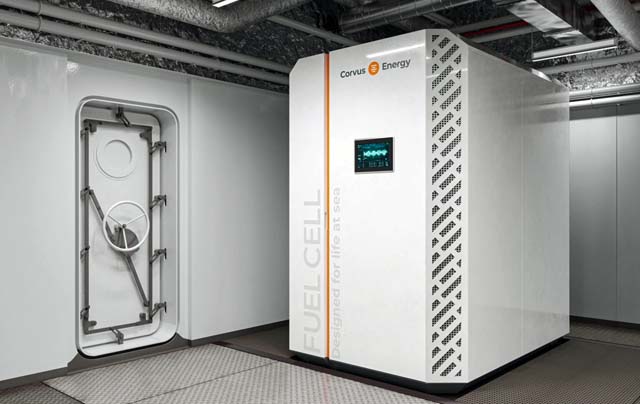
Maritime zero-emissions specialist Corvus Energy has been awarded funding for the integration of ammonia cracker technology with the company’s Pelican Fuel Cell system.
The project, titled ‘Apolo’, is a collaboration between several partners and aims to solve the challenges of power conversion from ammonia and develop an efficient and flexible ammonia cracking technology for the maritime sector. The four-year programme, starting in January 2024, will demonstrate power conversion from commercially available fuel cell systems using hydrogen from ammonia cracking with a power output of 125kW. The programme will test an ammonia cracker coupled with a novel ammonia engine running on an ammonia/hydrogen blend to compare the different technologies.
Partners in the project in addition to Corvus Energy are; H2Site, Tecnalia, Technische Universiteit Eindhoven, 1 CUBE, Chalmers Tekniska Hogskola, Nuvera, Astander, Fertiberia and LEC. Tecnalia will be the coordinator of the project.
Through the programme, Corvus Energy will work with H2Site and the other partners on the development, integration, testing and demonstration of the ammonia cracker and the Corvus Pelican PEM Fuel Cell. In addition, Corvus Energy will lead a work package developing a business case for these systems used onboard ships.
Project outcomes are hoped to advance zero-emission shipping and be a step forward for the use of ammonia in maritime transportation.
Svenn Kjetil Haveland, Corvus VP Development Projects said: “We are very grateful for the opportunity to collaborate on this exciting development. In decarbonising the maritime sector, ammonia will be an essential part of the energy mix for ships sailing the longest routes and that also emits the most. There are no commercially viable ammonia solutions available for the ship-owners as of today. Developing advanced methods for cracking ammonia and demonstrating scalability and overall system efficiency is an important step forward.”
The project funding is part of the Horizon Europe Framework Programme, Horizon-CL5-2023-D5-01. The technologies developed in Apolo will be capable of targeting the first 30,000 ships in the market. Initially, the focus will be on vessels with 1MW to 10MW propulsion, with a significant number of them being around 3MW in the next decade, as these are the first vessels relevant for ammonia-powered solutions.