
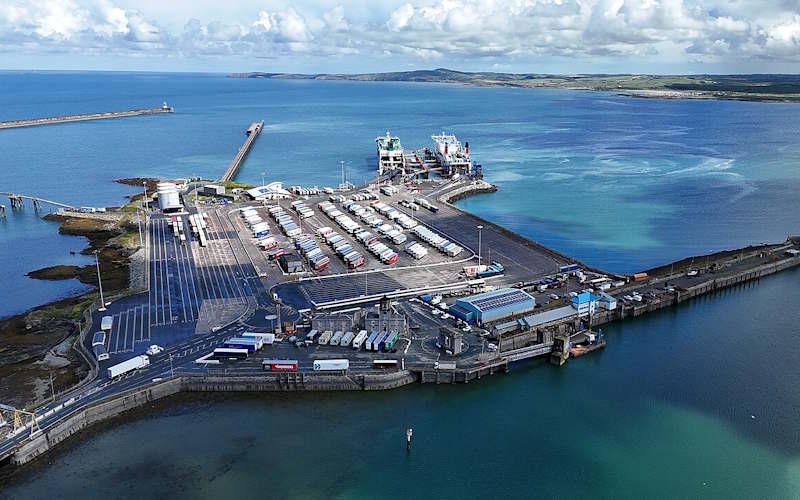
According to a new study led by environmental consultancy Ricardo, the ferry route between Dublin Port and the Port of Holyhead could serve as one of Europe’s first dedicated green shipping corridors.
The study identified green methanol as a suitable candidate fuel for the corridor with the potential to reduce GHG emissions up to 80%. The study, Greening the Irish Sea – The Central Corridor, was carried out in partnership with ferry operators Irish Ferries and Stena Line, as well as Dublin Port, the Port of Holyhead, with additional support from EDF UK R&D and Maynooth University.
Methanol was found to be the most practical alternative fuel for this route, offering the possibility of retrofitting existing vessels and benefitting from established bunkering and handling experiences compared with other emerging fuels. While additional safety measures are required, methanol is considered to present fewer operational challenges compared to ammonia or hydrogen. Battery-electric solutions were also explored but deemed infeasible due to the high energy demand, vessel size and operational flexibility needed on this route.
The Holyhead-Dublin trade route is the busiest ro-ro route between the UK and Ireland. In 2024, nearly 1.6m people travelled this route, with over 6,000 sailings accounting for more than 70% of all ferry passenger movements between the two countries. The ports of Dublin and Holyhead serve as key economic gateways, with Dublin Port alone handling almost 80% of Ireland’s unitised freight. This study aims to advance the decarbonisation of this critical trade artery. This study aims to advance the decarbonisation of this critical trade artery.
Matthew Moss, Ricardo Maritime Sustainable Transport Principal Consultant Research, said: “This study shows that the Holyhead–Dublin corridor offers strong potential as an early green shipping route in Europe. The combination of high traffic volumes and vessel suitability means it is a realistic location to trial alternative fuels at scale. While additional infrastructure investment will be required, methanol offers a pathway that can be enabled in the near term through vessel retrofits and established handling practices. To build on this work, clear policy signals and government support will be essential in creating the conditions for investment and deployment, helping accelerate the wider decarbonisation of the maritime sector.”
Johan Edelman, Stena Line Irish Sea South Trade Director, added: “It is incredibly encouraging to see the results of this feasibility study highlight Dublin-Holyhead as a potential green corridor. Sustainability is a strategic priority for Stena Line and as part of our long-term vision for a greener future, we commissioned two new freight ships for the Irish sea – both equipped to operate on methanol fuel. These ships have been purpose-built for the Belfast – Heysham route with the first is due to enter service on 22 September. We welcome government support to allow us to continue to offer cleaner more efficient transport solutions across our Irish Sea network.”
Irish Ferries MD Andrew Sheen, said: “We see a clear pathway toward operating a green corridor, but significant infrastructure development is needed across the supply chain to make alternative fuels cost-competitive with conventional options. We strongly urge our governments to reinvest the substantial revenues generated through carbon taxes into research, development, and the scaling of alternative fuels and their supporting infrastructure.”
Ken Rooney, Head of Engineering and Sustainability, Dublin Port Company, said: “We welcome this initial report and are looking forward to taking this to the next stage. One of the major challenges for critical infrastructure providers such as Dublin Port is the emergence of multiple possible alternative fuel options. Focusing on green methanol as one of these options gives us and the project partners a clear, realistic potential option to reducing emissions on this critical sea route. This presents an opportunity to have a material impact on marine emissions in the Irish Sea and gives us a better understanding of the needs of the sector, particularly in relation to energy supply. We are ready to work with our partners and customers to build upon the work of this initial study.”
Dr Patrick Rigot-Müller, Lecturer in Operations and Supply Chain, Maynooth University, said: “Dublin-Holyhead is one of the main northern European ferry corridors in terms of potential for CO2 reduction. It is well-suited to serve as a demonstration project for Green Shipping Corridors in Europe. We’ve been delighted to be able to contribute to the understanding of green corridors for this busy route.”
Rebecca Rosling, EDF Head of Future Energy Systems R&D, said: “The energy transition demands action across all sectors, and maritime transport remains one of the most challenging and carbon-intensive. At EDF UK R&D, we are proud to have contributed our technical expertise to the Holyhead–Dublin Green Corridor initiative. This project exemplifies how targeted innovation – such as the adoption of e-fuels like e-methanol, produced using low-carbon electricity – can accelerate decarbonisation in high-impact areas. At EDF R&D UK our mission is to help build a brighter energy future for the UK, and we see green corridors like this as a vital step toward a sustainable, low-carbon society.”
Image: Holyhead Port (source: Wikimedia Commons, licensed under the Creative Commons Attribution-Share Alike 4.0 International license)