
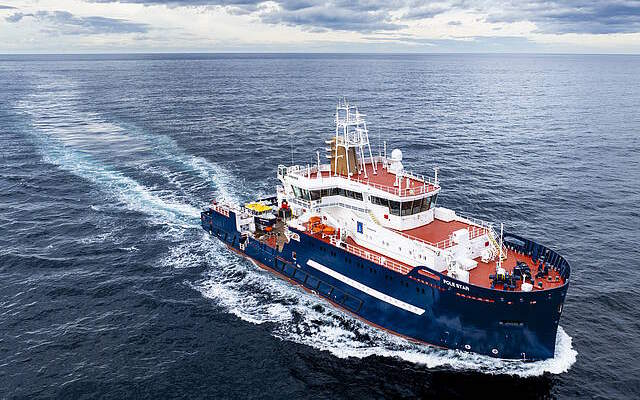
German propulsion company Schottel has been chosen by Spanish shipyard Astilleros Gondan to provide the propulsion package for the Northern Lighthouse Board’s (NLB) newest vessel ‘Pole Star’.
The ship was officially named in January 2026 by Her Royal Highness the Princess Royal, Patron of the NLB. The Pole Star is designed to conduct hydrographic surveys as well as buoy and lighthouse servicing across Scotland and the Isle of Man.
Phil Day, NLB Director of Operations, said: “A Schottel solution was offered by Gondan, who won the contract to build Pole Star following an open tender process, as part of the package. NLB is delighted to be using this equipment and entering into a relationship that will last the lifetime of the vessel.”
Designed to maintain and service lighthouses, buoys, and other marine aids to navigation, Pole Star requires high manoeuvrability supported by reliable propulsion. To meet these demands, the vessel is equipped with two Schottel SRP 460 LE rudder propellers and two STT 2 transverse thrusters. This configuration is intended to provide a high level of system redundancy, enhancing the vessel’s reliability and operational safety. It fully supports the vessel’s advanced DP capabilities, ensuring precise station-keeping even under demanding conditions.
In line with NLB’s commitment to efficiency and sustainability, both SRPs are installed in the LE-Drive variant (embedded L-drive). The vertically integrated electric motor eliminates the need for an upper gearbox, resulting in higher mechanical efficiency, reduced fuel consumption and lower vibration and noise levels. Its low installation height enables a compact integration into the vessel. To further reduce noise and vibration, the STTs feature an elastically mounted well installation, enhancing onboard comfort. This design allows for inspection of the thrusters inside the thruster room for maintenance purposes.
To meet stringent environmental requirements, the thrusters are equipped with Schottel LeaCon, a DNV-type approved seal monitoring system that offers protection against seawater contamination from lubricating oil. LeaCon monitors seal condition, enabling early detection of operational wear and reducing the risk of unscheduled maintenance.
The new Pole Star replaces a fourth vessel of the same name, which has reached the end of its economic service life after many years of operation. The newbuild delivers improved seakeeping performance, safer and more efficient buoy handling operations, as well as towing and firefighting capabilities. In addition, the ship offers enhanced crew accommodation and environmental benefits compared to her predecessors.
Image: The ‘Pole Star’ is designed to conduct hydrographic surveys as well as buoy and lighthouse servicing across Scotland and the Isle of Man (source: Schottel)