
According to LNG industry collective Sea-LNG, the European Union has been a driving force for maritime decarbonisation, with the methane pathway positioned to bring this ambition to reality.
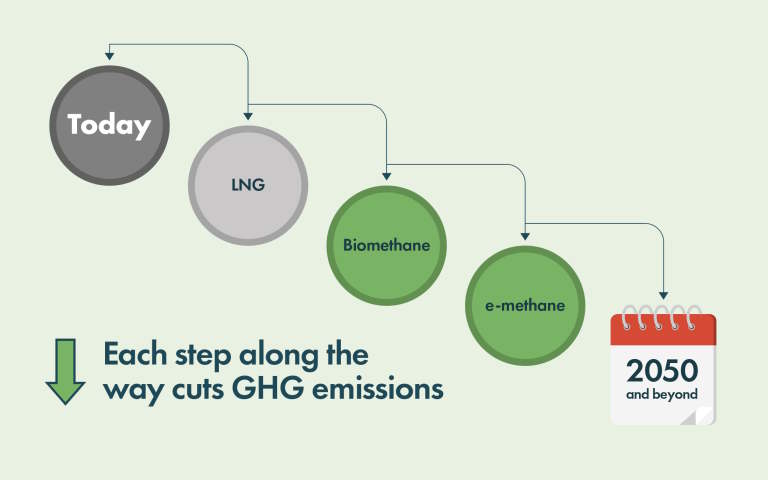
Offering what is said to be a proven route from LNG today, through biomethane, to e-methane, each step promises to deliver measurable emissions reductions without waiting for tomorrow’s infrastructure. With proven GHG and local emissions reductions, existing bunkering networks already in place, and growing EU regulatory support, methane could deliver both decarbonisation and energy security – now and into the future.
Sea-LNG’s fact sheet explores how the methane pathway supports the EU’s clean industrial ambitions. The methane, or methane decarbonisation, pathway refers to the pathway to net-zero based upon utilising the properties of the methane (CH4) molecule to power deep-sea shipping. This pathway is considered important for hard-to-decarbonise industries such as deep-sea shipping for which electrification is not a viable option for the foreseeable future. For deep-sea shipping, the pathway is based upon cutting local and some GHG emissions today by converting to clean LNG from traditional HFO and steadily increasing the share of renewable biomethane and e-methane in future years.
Sea-LNG considers the methane pathway a better solution for low emission shipping because the bunkering infrastructure already exists, the fuel is proven operationally from a commercial and safety perspective, and as an almost pure single molecule (CH4) fuel. Swapping fossil-derived LNG for liquefied biomethane and e-methane requires no modification and does not carry blending risks associated with some other biofuels. In short, methane is seen as the practical and realistic option today.
EU production of biomethane in 2024 increased by 21% year on year, representing about 7% of total European gas demand. Increasing production of biomethane boosts both EU industrial capacity and reduces GHG emissions by replacing fossil-derived methane in transportation and heavy industry. e-methane production is at an early stage in Europe with 35 projects in operation, accounting for about 2,800 GWh production pa, with a further 20 plants under development.
Fossil-derived LNG is a globally produced and traded commodity with the largest exporters USA, Australia and Qatar being allied to the EU. African production of LNG is also expanding. In the medium term the potential to grow domestic biogas and biomethane production is huge. By 2040 the sector could deliver approximately 101 bcm of biomethane to the EU, covering more than 80% of gas consumption, making a major contribution to EU energy security.
Methane, unlike other alternative marine fuels, can be moved into and across the EU via the existing EU natural gas infrastructure. The EU can assist competitiveness by ensuring European industries and maritime transport have access to sufficient amounts of biomethane and e-methane irrespective of where it has been produced (inside or outside the EU).
Sea-LNG believes the EU should prioritise funding for low and zero carbon maritime fuel production including liquefied biomethane and e-methane. It should also uphold technology neutrality and performance-based decarbonisation targets. Policymakers should set clear targets and enable business and industry to choose the most efficient way of reaching them. The EU should ensure that EU ETS and FuelEU Maritime align with evolving IMO measures, avoiding overlap or duplication, to streamline compliance, prevent double regulation, and achieve decarbonisation more efficiently and fairly, with the EU focusing on driving effective global implementation and ambition at IMO.
The Sea-LNG fact sheet can be downloaded here.