
SEA-LNG, the multi-sector coalition spanning the LNG value chain, has published its 2026 Mid-Year Market Review, providing a snapshot of the current market conditions facing the methane pathway, with particular focus on the growth of liquefied biomethane (LBM/bio-LNG).
According to analysis of vessel orders from January to June 2026 from DNV, LNG dual-fuel orders remain robust at 73 vessels, accounting for almost 90% of the alternatively fuelled order book, when compared with ammonia, hydrogen and methanol. Additionally, there are now 67 LNG bunker vessels in operation, plus 42 more on order.
The LNG order book continues to be dominated by vessels serving liner trades especially container vessels and PCTCs. This is consistent with recent analysis by the World Shipping Council which shows that LNG remains the preferred fuel for container ship owners, accounting for 58% of total tonnage ordered versus conventional fuels at 36%.
There was an increase in bunkering volumes and infrastructure. According to analysis by Kpler, global LNG bunker volumes were around 770,000m3 per month in the period January to May 2026. This represents an increase of about 13% on the same period in 2025 as more LNG fuelled vessels have entered into operation together with favourable LNG and conventional fuel prices.
LBM is bunkered routinely today, and liquefied e-methane is in development. Since the introduction of regulations like FuelEU Maritime, LBM supply and demand have grown significantly. Data from the European Biogas Association show biomethane production capacity reached 8.2 bcm a year by the end of Q2 2026. This represents an additional 1 bcm in a single year, or growth of 17%. The number of operational biogas plants rose from 1,678 to 1,975 plants with €36bn of allocated capital investment driving the sector.
Steve Esau, Sea-LNG COO, said: “Despite geopolitical and regulatory uncertainties in 2026, the industry is maintaining momentum on the methane decarbonisation pathway. This year’s mid-year review confirms that methane is the practical and realistic solution for shipping decarbonisation. This is reflected in the growing numbers of LNG-fuelled vessels, LNG bunker vessels, and LNG bunkering volumes, as well as biomethane bunkering and production growth. As we look ahead, with e-methane also materialising, we are confident in the trajectory of the methane pathway to decarbonisation.”
Sea-LNG is active at the IMO and EU to underline the importance of goal-based and technology-neutral decarbonisation regulations, and ensure a global market for low and net zero fuels. As the methane pathway continues to mature, efforts have shifted from raising awareness to sharing members’ collective expertise on important technical details that will, for example, further reduce global well-to-wake emissions and scale up bio- and e-methane development and deployment. As part of these efforts, Sea-LNG has now been granted provisional consultative status at the IMO. This status will enable it to engage directly with member states as it advocates for practical and realistic regulations to help move the maritime industry forward.
Peter Keller, Sea-LNG chairman, added: “I have been with Sea-LNG since we founded it 10 years ago, and what strikes me is how methane has ramped up from a pathway to a clear runway for shipping decarbonisation. When building the first LNG-powered containership, I didn’t imagine that within ten years over 10% of the global fleet by deadweight could be powered by methane. What started as a solution to reduce harmful local emissions has cemented itself as the practical and realistic option for reducing greenhouse gas emissions today and into the future. As I look ahead, the fundamentals are strong, the orderbook is growing, the bunkering infrastructure is expanding at a record pace, and biomethane and e-methane are building on LNG’s foundation. Just as we expected.”
The review can be downloaded here.
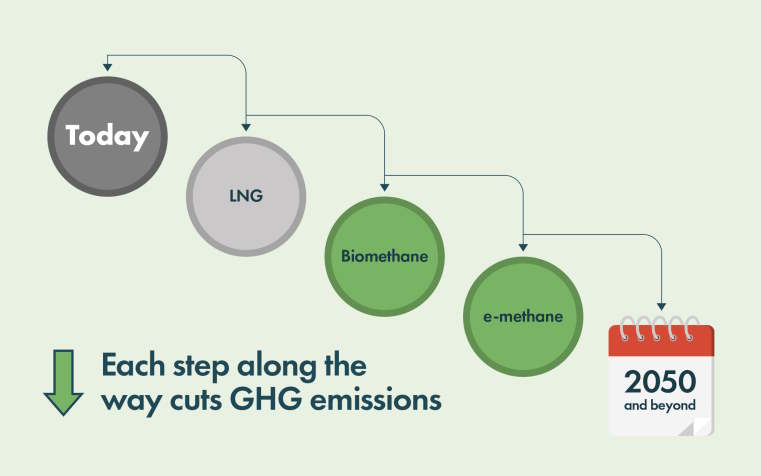
Image: The methane pathway to 2050 and beyond (source: Sea-LNG)