
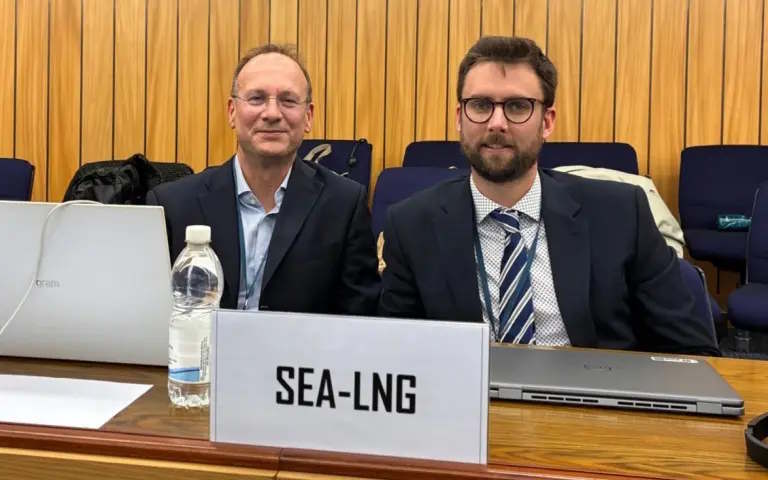
Until recently, LNG industry collective Sea-LNG felt it was missing something important: the chance to bring its experience into the room at the central maritime regulator, taking the opportunity to make the case for methane on an equal basis with advocates for other technologies and fuels.
Since July 2026, the IMO Council has granted Sea-LNG consultative status, allowing it to take part in meetings on GHG emissions, alternative fuels and ship safety. Sea-LNG’s message is that methane – the principal constituent of LNG – is already part of shipping’s energy transition. It believes that fossil LNG, biomethane and synthetic methane offer a pathway that can develop and scale materially over time, supported by infrastructure and operational experience that exist today. As the IMO shapes the rules for the decades ahead, Sea-LNG wants its experience, and the lifecycle emissions of each pathway, to be part of the conversation.
According to the organisation, its membership began making LNG work as a marine fuel (long before ‘shipping’s energy transition’ became a familiar phrase). They took the first steps when much was still uncertain. One vessel was followed by another. One port learned from the next. Crews were trained, procedures tested, standards developed and confidence earned. Today, LNG can be bunkered around the world. That did not happen on paper. The members made it happen, and their experience is said to offers lesson for every new fuel finding its place in shipping.
At the IMO’s recent sub-committee on carriage of cargoes and containers (CCC), Sea-LNG contributed to discussions on alternative fuel safety. Behind every fuel pathway are the people who must supply it, bunker it and use it on board. If the transition can succeed, it must be able to do so safely. Onboard carbon capture and storage (OCCS) was part of the discussion too. Sea-LNG regards this as an enabling technology with the potential to reduce emissions from ships using methane pathways. That matters for new vessels, and for the ships already at sea. The existing fleet has to decarbonise too.
Sea-LNG has been making its case, and has brought it into the IMO room. Its delegates contribute to the development of safety guidelines for ships fitted with OCCS systems, because promising technology needs a safe path into operation. This is an area where members’ experience can help turn potential into practice.
The organisation points out that it welcomes conversations at IMO with delegates who see things differently, including those who question methane’s place in shipping’s future. These exchanges challenge those taking part to make their case clearly, hear concerns directly and find practical ways forward. Sea-LNG acknowledges that the methane pathway must keep improving to earn its place in shipping’s long-term future. There is more work to do on methane emissions, monitoring and reduction.
Sea-LNG’s recent involvement has strengthened its belief in the IMO’s work. Shipping needs a global forum to tackle global challenges such as GHG emissions together. It also needs the IMO’s continuing work to keep ships and seafarers safe. It is the people who work at sea who will be the ones who make this transition happen.
Sarah Smith, Director, Sea-LNG member FortisBC, said: “Being a member of Sea-LNG helps FortisBC work with industry partners to reduce the use of higher carbon fuels in marine applications. With nearly 50 years’ experience in LNG production in Western Canada, FortisBC sees tremendous continued opportunity in marine bunkering, and our membership allows us to work together to overcome obstacles, innovate and take meaningful climate action.”
Tim Nolan, President and CEO, TOTE, added: “By leveraging the environmental benefits of LNG, TOTE is creating positive outcomes for those we serve and the communities in which we operate, enhancing our ability to provide customers a safe, reliable and sustainable service product and delivering significant public health benefits through the reduction of greenhouse gas emissions.”
Image: Steve Esau and Andy Wilbroe at IMO (source: Sea-LNG)