
Independent maritime asset owner and operator Seaspan Corporation has announced a deepened strategic collaboration with A.P. Moller-Maersk (Maersk) focused on enhancing the efficiency of their time-chartered fleet.
Building on more than 20 years of partnership, the two companies are advancing a comprehensive vessel efficiency programme across 18 vessels on long-term charter to Maersk. The programme is aimed at unlocking measurable gains in fuel efficiency, cargo capacity, operational flexibility, and emissions reduction. As a cornerstone initiative, the partners have jointly developed high-impact retrofit solutions for four 13,000 TEU vessels, representing one of the most significant upgrade programmes for the shared Seaspan – Maersk time charter fleet.
The retrofit solution consists of the installation of a shaft generator to reduce auxiliary engine fuel consumption, main engine performance optimisation, a new high-efficiency propeller and pre swirl device to improve propulsion efficiency, and carbon capture readiness to prepare the vessel for future emissions regulations. In addition, the lashing bridge will be elevated to increase cargo carrying capacity, and the deadweight will be increased to enhance loading capability. Together, these retrofit measures are expected to improve the vessel’s slot cost by approximately 10–13%, while enhancing fuel efficiency, operational performance, and regulatory readiness.
To date, combined investments in fleet upgrades for the 18 vessels, completed and planned, are approximately US$ 75m, with further initiatives under development to support continued decarbonisation and performance gains.
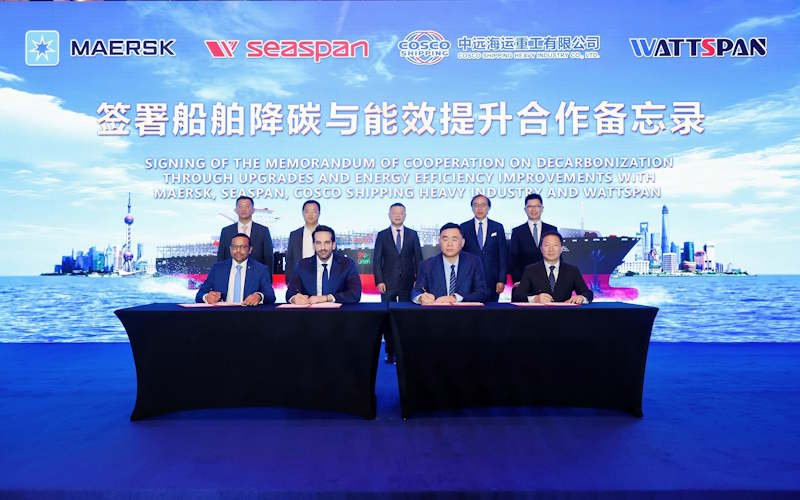
Separately, WattSpan—a strategic maritime technology and engineering joint-venture partner to Seaspan focused on vessel performance, energy efficiency, and decarbonisation solutions—has joined Maersk and Cosco Shipyard in signing a non-binding Memorandum of Cooperation, establishing a one-year framework for collaboration on vessel upgrades, energy efficiency improvements, and maritime decarbonisation technologies. Initiatives include, but are not limited to, joint development, information sharing, and future project execution under separate commercial agreements.
Dimitrios Panagopoulos, Chief Fleet Operations Officer, Seaspan, said: “This partnership reflects the kind of practical, high-impact collaboration needed to advance decarbonisation across the maritime industry. By working closely with Maersk, WattSpan, and Cosco Shipyard, we are combining technical expertise, operational insight, and long-term investment to improve vessel performance today while preparing our fleet for the fuels and technologies of the future. It is a strong example of how trusted partnerships can deliver meaningful progress at scale.”
Anda Cristescu, Maersk Head of Chartering and Newbuilding, added: “For many years, Seaspan has been a valued partner and significant provider of tonnage to the Maersk fleet. By working closely with Seaspan, we aim to implement vessel upgrades that reduce fuel costs, lower greenhouse gas emissions, and increase cargo capacity – all of which enhance the competitiveness of our fleet.”
Image: Signing of the decarbonisation agreement (source: Seaspan)