
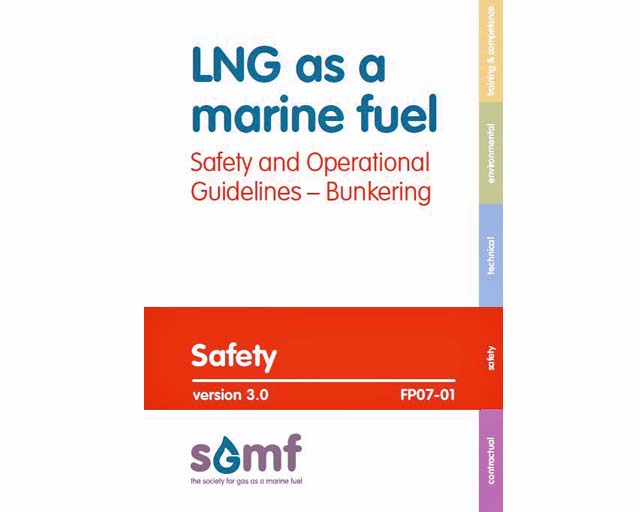
The Society for Gas as a Marine Fuel (SGMF) has released a third edition of its ’LNG as a marine fuel – Safety and Operational Guidelines – Bunkering’ publication, said to offer more comprehensive coverage in more detail than anything previously available.
A growing trend towards adoption of LNG as fuel partly results from the considerable expansion of the LNG bunkering supply infrastructure, with facilities now well established in most parts of the world, with more operational LNG bunkering vessels. In anticipation of this growth and beyond, the safe use of LNG as a marine fuel has been a priority issue for SGMF. First published in 2014, the SGMF’s LNG as a marine fuel – Safety and Operational Guidelines – Bunkering publication has been significantly updated and revised for 2022. SGMF has played a leading role in developing a ‘safety first’ approach to bunkering operations through its publications, work, and influence.
Today amongst the SGMF membership organisations there are tens of LNG bunkering ships operating with hundreds of ships using LNG between them, with LNG bunkering occurrences now in their thousands.
These latest guidelines take a holistic approach, incorporating recent operational experience, and starting from the design of bunkering vessels and facilities to the planning and preparation of the bunkering operations and locations, and guidance on safe fuelling operations. The publication covers not only actual operations, but also the actions and activities leading up to that final stage, making the bunkering efficient and safe.
Chairman of SGMF and COO Nakilat, Samir Bailouni, said: “The information contained in this publication is gold dust for anyone bunkering an LNG fuelled ship. These practices and insights are collated from the best the industry has to offer, and I extend my thanks to our members for providing this invaluable information not only for the benefit of the industry, but for society as a whole.”
Mark Bell, GM SGMF, said: “The safe and sustainable use of gaseous marine fuels are the core objectives for SGMF and these bunkering guidelines for LNG are a cornerstone reference for the industry. As the industry grows, being able to supply new entrants with these guidelines provides them with a valuable head start in ensuring they can operate with maximum safety and efficiency, no maritime gas fuelled project should be without them. The industry now has a comprehensive portfolio of publications for LNG as a marine fuel and the Society will continue to update them with good, if not the best, practice the industry has to offer. Whilst the industry currently debates other future gaseous marine fuels such as ammonia and hydrogen, be assured SGMF is currently working on and will produce further guidelines for these fuels in a similar manner to what it has done for LNG. Meanwhile, I strongly encourage and advocate the continued focus on safe and sustainable bunkering for all these fuels through support for the important work and leadership of the Society in these aspects.”
LNG as a marine fuel – Safety and Operational Guidelines – Bunkering provides information relevant to all stakeholders, from ship owners and operators, suppliers of LNG as a marine fuel, maritime administrations, port authorities and terminal operators, and local and national authorities.
Bell said: “Bunkering LNG involves a range of potential hazards, but when good practice is applied and followed, the risks can be effectively mitigated. The overall aim of this new publication is to ensure that gas-fuelled ships can be bunkered safely, reliably, efficiently, and in an environmentally responsible way. It has only been made possible through the partnership, cooperation, support and open information from of our members.”
The publication addresses the specific requirements for LNG used as a marine fuel, as well as synthetic and bio-LNG. Its content may also, with appropriate limitations, be used as a reference for other low-flashpoint fuels and systems not specifically addressed in these guidelines.