
Norwegian shipowner Solvang has been working with Wärtsilä on Carbon Capture and Storage (CCS), which it sees as a game changer in CO2 emissions.
Solvang accepts that as yet there is no working technology for shipboard CCS, while at the same time deep-sea transportation has no access to the amount of truly green fuel necessary to replace conventional fuel oils, either HFO or LSFO. Over the last 20 years the company has been working on optimising engine operation, emission cleaning and exhaust recirculation, to benchmark conventional HFO with LPG, LNG, biofuels and others in terms of GHG emissions. After removing NOx, SOx, and other pollutants from the exhaust, the problem with CO2 remains, since there can be no combustion without carbon output.
Solvang CEO Edvin Endresen said: “There are no easy solutions, so we are looking for the big game changer: To avoid CO2 emissions by means of capture and storage.”
In 2021, Solvang and Wärtsilä launched a vessel scale CCS project, aiming to capture CO2 from main engine combustion before it passes through the exhaust outlets. A complex carbon separation process takes place inside the smokestack, resulting in liquid CO2 being transferred to deck tanks, ready for long-term storage or industrial reuse. A complete setup of scrubber plus CCS installation is running in a 1.2MW full-scale test environment at Wärtsilä´s facility in Moss, Norway.
Endresen said: “The system already runs up to 60% carbon capture on some engine loads, which has never been done before. Furthermore, initial indications are that the CO2 captured is very pure, with little or no product contamination.”
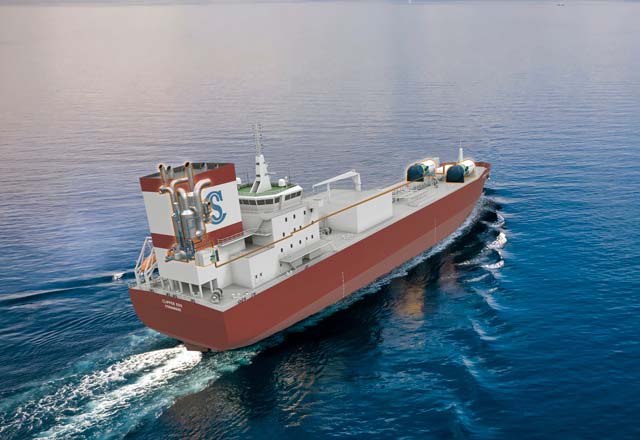
The next stage is to instal an upscaled solution on ethylene carrier Clipper Eos, where it will serve the 7MW main engine. By mid-2022, Solvang expects to be able to instal an electrostatic filter in the vessel´s exhaust gas cleaning system, as a first-time experiment in ship engine technology.
If everything works well, carbon absorber and stripper units will be installed towards the end of 2023, as well as modification of liquefaction systems to cater for deck tanks. The following two years, a complete CCS setup will operate alongside the existing scrubber and exhaust gas cleaning systems onboard Clipper Eos, providing a stream of live data.
Solvang fleet director Tor Øyvind Ask said: “The scheduled combination of CCS, scrubber and Solvang´s low-pressure EGR system will handle CO2, NOx, SOx, particles, CO and unburnt fuel from the HFO combustion. If applied to deep sea shipping as a sector, it constitutes a great step towards net-zero emission.”
Solvang points out that fossil-based fuels like fossil fuels like MGO, VLSO, LPG, LNG and HFO only offer a 10-15% potential reduction in GHG emissions – as opposed to climate goals where the target is net zero. If highly potent greenhouse gases such as methane slip are included, fuels like LNG may score even lower. When shipboard CCS becomes available, HFO could turn out to be the climate-winner among fossil fuels when accounting for carbon in a life-cycle perspective from extraction of oil through mileage of the cargo, often called well-to-wake.
Solvang believes that after CO2 extraction, HFO will score better than all other fossil fuels, as well as challenging e-fuel due to processing costs like coal-fuelled generation of electricity affecting its life-cycle CO2 budget. Even when e-fuel comes from zero emission sources, there is little hope to cover deep sea shipping’s needs with this energy source within the next decades.
Ask said: “To expect all sectors to plunge emissions at the same time will not work. Air traffic will place the highest bid for e-fuel, leaving shipping to opt for other fuel types. CCS is something we can do within a few years. When the world has sufficiently green energy, the captured CO2 can be transformed into electro fuel. Summed up, we offer a bridge into decarbonised deep sea shipping, thereby contributing seriously to our common future.”