
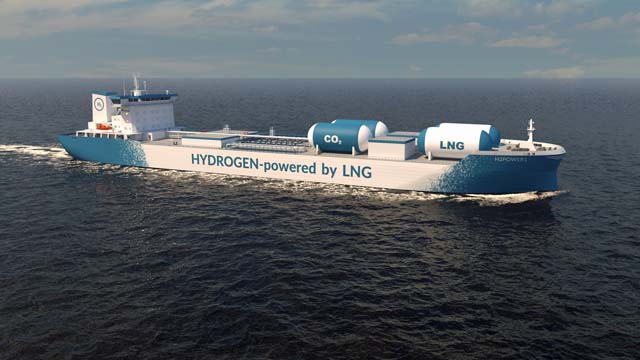
Swedish ship designer FKAB has received an Approval in Principal (AiP) from RINA for an MR tanker design using LNG with steam to produce Hydrogen, for propulsion, and CO2.
A gas reformer will produce hydrogen to supply the main engine as well as a bank of ABB fuel cells. CO2 produced by the gas reformation process will be captured directly from the reformer rather than from the exhaust gas, and stored onboard.
RINA believes this is the first AiP to be issued which achieves IMO’s 2050 decarbonisation targets and is based on currently viable technology and fuels. Conceived by the class society and designed by FKAB, the system combines the LNG ship fuel with steam to split LNG molecules, producing hydrogen and CO2. The technology is the result of a joint project with ABB and Helbio (a subsidiary of Metacon).
Antonios Trakakis, Greece Marine Technical Director, RINA, said: “To meet CO2 reduction targets, shipping is faced with the challenge of having solutions which either rely on fossil fuels, but which still require technology to mature, or on new, zero carbon fuels, the availability of which is still far from being guaranteed. This new design enables the use of hydrogen as a fuel today without the need for bunkering and storage on board and exceeds IMO 2050 targets for 70% reduction of carbon intensity.”
The hydrogen produced by the gas reformer is directly used to fuel the internal combustion engines and fuel cells in a hybrid marine power system developed by ABB.
According to FKAB, any solution that aims to reduce a ships’ CO2 emissions today should ensure a competitive Carbon Intensity Index (CII) rating – which has increasingly stringent rating thresholds towards 2030 – throughout the whole service life of the vessel, not only when getting closer to 2050. This may prove to be a substantial limitation for conventional ships built with the intention of being retrofitted after 10-15 years from delivery. With this technology, hydrogen usage can be progressively increased to maintain a top CII rating throughout the life of the ship, reducing CO2 emissions in a parallel slope with the applicable regulations. The ship can meet full decarbonisation targets by either running the engine on 100% hydrogen, or by producing all the power needed by fuel cells. In this way, the owner can decide the rate of CO2 reduction.
Carbon disposal will be a vital technology for the future to meet global decarbonisation goals across all sectors. The concept is not expected to require onshore carbon disposal technology to be available before 2032.
Andreas Hagberg, Head of Sales and Marketing, FKAB, said: “The concept is revolutionary because it does not require any portside hydrogen infrastructure. The hydrogen is created onboard the vessel and all necessary equipment can be easily fitted on deck, so ship owners can convert existing vessels. The fuel cells have been specifically developed to produce more power and fewer emissions.”
CO2 is liquefied by the cryogenic steam from the LNG and can be used as inert gas for the tanker. No additional bunkering, aside from normal LNG, is required. The hydrogen produced can be used to power the main engine, or fuel cells, or a hybrid of the two. The AiP covers the hybrid option.
Trakakis concluded: “Now that the concept has been brought to the real world through an immediately applicable CII A rated design, this opens the door to reduce emissions in a much shorter timeframe. The AiP is for an MR tanker, but the technology can be applied to a wide range of vessel types and sizes.”