
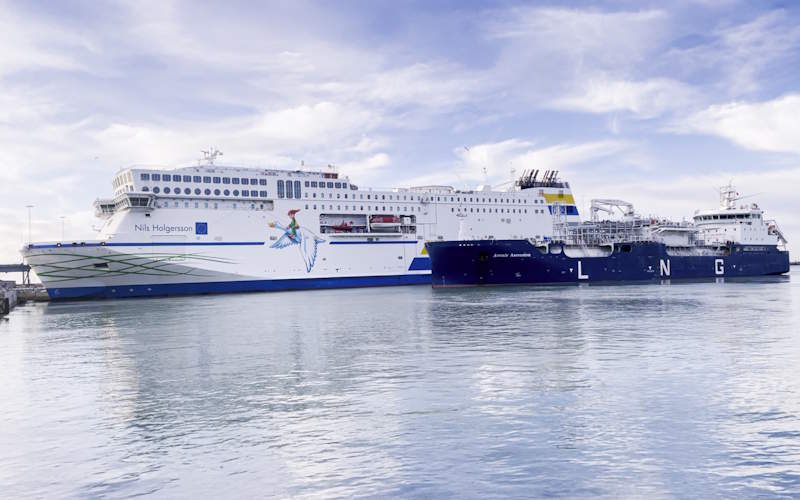
German ferry operator TT-Line has revealed that, working closely with Everllence PrimeServ Germany, its ro-paxes ‘Nils Holgersson’ and ‘Peter Pan’ successfully operated on bio-LNG during 2025, enjoying a significant emissions reduction.
The 230m vessels were commissioned in 2022 and 2023 respectively and are each powered by four medium-speed engines, two 8L51/60DF and two 6L51/60DF. They operate in the Baltic Sea between Germany, Sweden, Poland and Lithuania.
TT-Line and Everllence discussed the use of bio-LNG as a substitute for fossil-LNG fuel, strengthening the long-term technical cooperation between the two organisations. This collaboration overlapped with continuous emission measurements on board the Nils Holgersson that Everllence carried out for almost a year in support of optimisation of operations.
This revealed:
- no significant ageing effect on the engines related to methane emissions;
- emission values from the test bed could be reproduced by measurements on board;
- no negative influences on engine operating-parameters during bio-LNG operation.
Andreas Schaerli, COO TT-Line, said: “With the use of climate-neutral bio-LNG, which is obtained from waste materials, TT-Line is making a decisive contribution to climate protection on the Baltic Sea. Thanks to this technology, our Green Ships – the Nils Holgersson and the Peter Pan – enable a CO2-free journey throughout the entire fleet. Our customers can already fully compensate for their crossing by adding bio-LNG during the booking process. We are thus consistently focusing on innovative solutions to sustainably reduce emissions and shape the future of ferry transport in a climate-friendly way.”
The bio-LNG is sourced from agricultural waste in northern Europe where biogas is fed into the grid and then extracted, liquefied and loaded onto a bunker vessel, which transports the climate-neutral fuel to the respective TT-Line vessels. Replacing one tonne of fossil LNG with bio-LNG saves 2.75t of CO2 emissions, equivalent to a 100% reduction.
Dr Michael Filous, SVP and Head of PrimeServ Germany, Everllence, said: “The key benefit associated with bio-LNG is the reduction in CO2 emissions. A major advantage for the customer is that while there are specifications that the fuel gas needs to fulfil – such as methane number – no additional engine works are necessary as long as the fuel gas meets the specifications. Indeed, this was the case for the Nils Holgersson.”
TT-Line further states that it is delighted with the positive experience gained from the uptake of renewable fuels during the collaboration. The resulting emission savings contribute to the reduction of TT-Line’s fleet emissions in the Baltic Sea through pooling. From an administrative perspective, this process is supported by certificates issued by the fuel supplier, which document the emission savings achieved by using biofuels compared to conventional fuels.
Image: Ro-pax ‘Nils Holgersson’ bunkering bio-LNG (source: Everllence)