
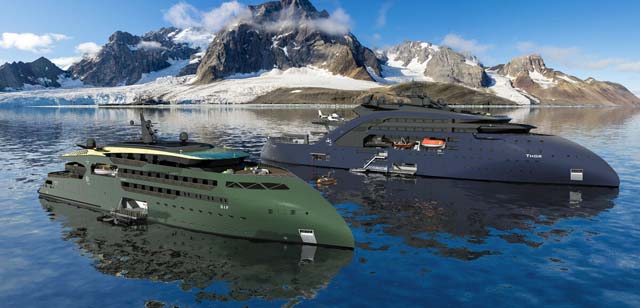
Norway-based ship building and design company Ulstein has launched ‘Ulstein Thor’, a 149m 3R (Replenishment, Research and Rescue) design which will feature a Thorium Molten Salt Reactor (MSR) to generate large amounts of clean, safe electricity, to enable the vessel to operate as a mobile power/charging station for battery driven expedition cruise ships.
Ulstein believes the concept, known as ‘Thor’, may be the missing piece of the zero emissions puzzle for a broad range of maritime and ocean industry applications. To demonstrate its feasibility, Ulstein has developed the Ulstein Sif concept, a 100m long, 160-person capacity, zero-emission expedition cruise ship. This Ice Class 1C vessel will run on next-generation batteries, utilising Thor to recharge while at sea.
Ulstein CEO Cathrine Kristiseter Marti said: “We have the goals, ambition and environmental imperative to switch to zero-emission operations, but, until now, we haven’t had the solution. We believe Thor might be the answer we’ve been looking for. Thor is essentially a floating, multi-purpose ‘power station’ that will enable a new battery revolution. Expedition cruise ships operate in increasingly remote, and environmentally fragile, areas. At the same time, the industry faces growing pressure from diverse stakeholders to preserve nature as it is and ban the environmental impact of cruising. Thor enables replenishment of energy and supplies on site, while also boasting the technology to facilitate rescue operations, as well as conducting research tasks. It is, in effect, a crucial piece of infrastructure to support sustainable and safer operations. Thor literally has the power to change our entire industry.”
Thorium has been identified as having huge potential for a maritime industry hunting for clean alternative fuels. MSRs are safe, efficient and operationally proven solutions that work by dissolving Thorium – an abundant, naturally occurring metal with low radioactivity – in liquid salt. The ensuing chain reaction heats the salt, producing steam to drive a turbine and create electricity. Although developments on land are well documented, its potential for delivering clean maritime power has yet to be incorporated into a vessel design. Ulstein has seen an opportunity to change that, potentially heralding a new dawn of clean power for cruise and maritime operations.
Thor’s charging capacity has been scaled to satisfy the power needs of four expedition cruise ships simultaneously. Thor itself would never need to refuel. As such, it is intended to provide a blueprint for entirely self-sufficient vessels of the future.
Jan Emblemsvåg, Professor at the Norwegian University of Science and Technology, an expert in the field of Thorium and nuclear power generation, said: “MSRs have enormous potential for enabling clean shipping. There is so much uncertainty over future fuels, but here we have an abundant energy source that, with the right approach, can be safe, much more efficient, cheaper, with a smaller environmental footprint than any existing alternative. From my perspective, I see this as the most viable, and potentially the only credible, solution for a zero-emission fleet that can operate under commercial terms and cost levels. The Thor concept is exactly the kind of innovation we need for sustainable success at sea.”
Øyvind G Kamsvåg, Chief Designer, Ulstein, said: “Here we have two concepts in one to showcase a cleaner, safer and more sustainable way ahead for cruise ship owners and operators, not to mention maritime in general. Thor and Sif demonstrate what is possible when we approach challenges from a new direction.”
Lars Ståle Skoge, Commercial Director, Ulstein Design and Solutions, concluded: “We have huge confidence in this solution and want to engage further in conversations about how we can enable the necessary changes the world demands. I’m excited to see where Thor and Sif can take us as we look to a zero emissions horizon.”