
Spanish wind assisted propulsion system (WAPS) developer bound4blue has taken another step forward in its mission to accelerate and simplify the adoption of wind power, with the validation of its ‘wind propulsion system force matrix calculation methodology’ by Lloyd’s Register (LR).
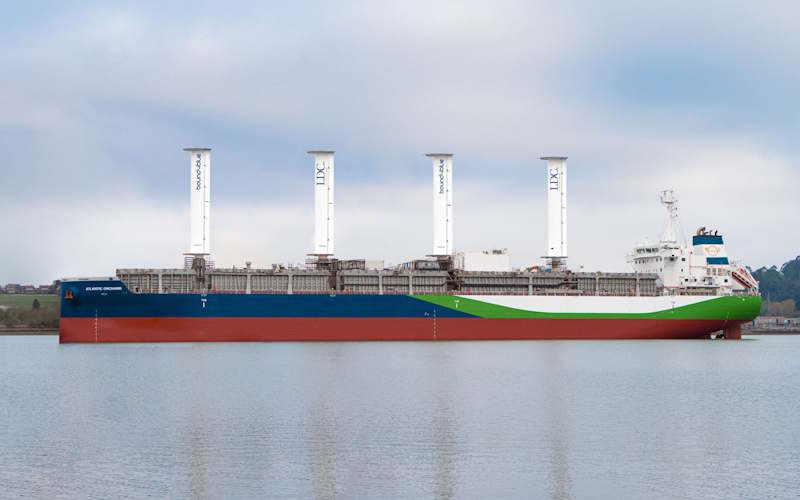
The validation is said to give shipowners a robust, credible and compliant means to calculate the Pwind value of installations, ensuring they unlock full regulatory (and cost) benefits under frameworks such as FuelEU Maritime, and EEDI/EEXI. LR validated the approach, which uses advanced CFD-based calculations, validated through wind tunnel tests. The installation earlier this year of four bound4blue eSails onboard juice carrier Atlantic Orchard, chartered by Louis Dreyfus Company (LDC) and owned by Wisby Tankers, is the first to benefit from this methodology validation.
With this validation, shipowners can take advantage of what is considered to be a reliable tool to calculate the regulatory benefits of the suction sail technology without the need for full-scale testing, saving significant time and money. This, according to bound4blue, helps build trust and ease acceptance for the company’s systems as WAPS takes off in the market.
Alberto Llopis, Head of Aerodynamics, bound4blue, said: “Validation by Lloyd’s Register is a key enabler for shipowners who want to realise the full value of wind propulsion By confirming our methodology aligns with all applicable international Rules and Standards, it ensures our clients can confidently calculate Pwind to simplify regulatory compliance and unlock substantial financial savings. It removes uncertainty and enables more informed decision-making, underlining the attractiveness of wind as a prime mover in maritime’s much-needed energy transition.”
Pwind is the calculated propulsive power available from a WAPS such as the eSail, and plays a central role in environmental compliance. Defined under IMO’s 2021 Guidance on treatment of innovative energy efficiency technologies (MEPC.1/Circ.896), Pwind can be deducted from a ship’s required engine power under EEXI/EEDI calculations, reducing the vessel’s regulatory burden. It is also directly linked to the wind reward factor in FuelEU Maritime, potentially relaxing GHG targets and lowering compliance-related expenses.
The force matrix – which represents the thrust characteristics of a WAPS under various wind conditions – must be installation-specific (considering both sail-to-sail and ship-to-sail aerodynamic interactions) and validated by an independent verifier. LR’s validation confirms that bound4blue’s methodology meets the standards set by IMO, ensuring consistency and transparency.
Dr Santiago Suarez de la Fuente, LR Advisory Ship Performance Manager, said: “As the maritime industry works towards ambitious decarbonisation targets, shipowners and technology developers need confidence that their investments align with both evolving regulatory expectations and their own objectives. At LR, we’re proud to support the safe and effective adoption of breakthrough technologies, such as bound4blue’s eSails, by providing transparent, independent validation shipping companies can rely upon. We’d like to thank both bound4blue and LDC for their excellent collaboration on this project.”
LR’s validation is seen as more than a standalone achievement. While force matrices must be calculated specifically for each ship and sail installation, the validated methodology is now transferable across future projects. This means that any new eSail installation using the same CFD-based approach can efficiently obtain a verified Pwind – streamlining compliance, accelerating project timelines, and making the business case for wind propulsion even stronger.
Fabian Kowatsch, LDC Shipping Decarbonisation Lead, said: “At LDC, we see validated wind power solutions as a clear win: one that supports our ambitious decarbonisation goals, saves fuel costs and delivers strong regulatory advantages. Thanks to the Pwind validation, we can now factor wind propulsion into our regulatory planning, accurately calculate the FuelEU Wind Reward Factor and significantly reduce our compliance costs.”
Demand for wind propulsion solutions, such as suction sails, is increasing since the advent of the FuelEU Maritime regulation. Wind is thought to be the only power source actively rewarded through the framework, with compliance targets for relevant vessels relaxed by up to 5%. eSails can create energy efficiency benefits for EEDI and EEXI, reduce emissions and costs relating to EU ETS, and positively impact CII ratings.
bound4blue’s fully autonomous units have seen recent orders placed by companies such as Maersk Tankers, Marflet Marine, Klaveness Combination Carriers, Eastern Pacific Shipping. The mechanically simple technology claims a typical payback period of less than five years and is suitable for either newbuilds or retrofitting across various vessel segments, including tankers, bulkers, ro-ros, cruise vessels, ferries, gas carriers and general cargo vessels.
Image: Juice carrier ‘Atlantic Orchard’, chartered by LDC, owned by Wisby Tankers, with four bound4blue eSails (source: bound4blue)