
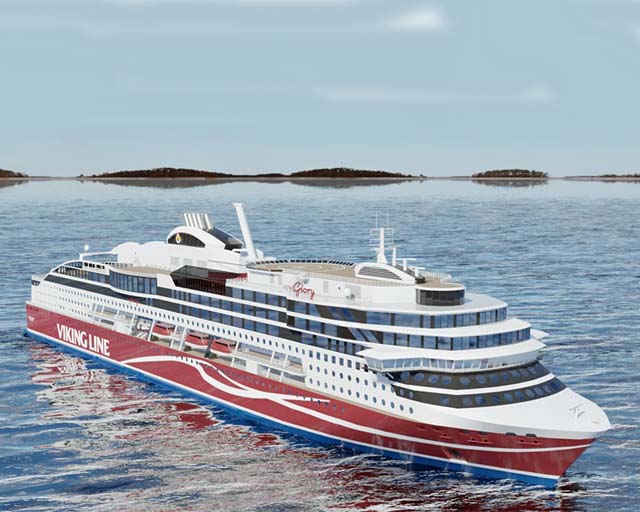
Finland’s Viking Line will be introducing its new flagship ‘Viking Glory’ into service in March 2022, meaning that the environmental impact of Viking Line’s vessels on the Turku–Mariehamn–Stockholm route will be further reduced.
Viking Glory has 66% more cargo capacity than the Amorella, which it will replace, but is expected to produce more than 25% lower emissions than its predecessor. Viking Glory and Viking Grace, which began serving the route in 2013, are now considered the two most climate-smart vessels sailing the Baltic Sea.
Viking Line’s sustainability manager, Dani Lindberg, said: “Efficiency, environmental requirements and the future were all taken into consideration in an entirely new way when Viking Glory was planned. Our flagship has been built as a tribute to our roots – that is, the Baltic Sea and the nature in its beautiful archipelagos. Most of our sustainability work involves different solutions that passengers don’t notice, like the vessel’s technical solutions, which have seen rapid advances. 10 years ago, Grace was the world’s most environmentally-friendly passenger ship and now Glory, which is bigger, will use about 10% less fuel. Glory’s Azipod propellers and other technical innovations save considerable time in port, which gives us leeway in terms of keeping to the timetable. Every minute saved in port results in fewer emissions during the sea journey. We also do daily route planning, which means we modify our journey based on weather conditions and timetables.”
The company is refitting its other vessels so that they are more energy-efficient throughout their life cycle: the steering and air conditioning systems are being updated, new technology is installed each year, and even the hull can be modified to reduce resistance. Divers regularly scrub the bottoms of the vessels to reduce water resistance and fuel consumption. As a result, no toxic bottom paints are needed.
“The vessels’ energy consumption and emissions will continue to be reduced going forward. The development of new fossil-free fuels and energy storage is proceeding at full speed, and we are closely monitoring these advances. We will be taking part in various trials and projects, for instance, testing new clean tech innovations and clean fuels,” said Lindberg.
Viking Glory is one of the first vessels to use Wärtsilä’s 31DF dual-fuel engines and run on totally sulphur-free LNG, enabling optimisation of fuel use while producing zero sulphur emissions and lower CO2 emissions than diesel engines.
Viking Glory’s captain, Ulf Lindroos, said: “When Viking Grace started running on LNG, sulphur and particulate matter emissions were reduced by 85% while greenhouse gas emissions were reduced by 15% compared to oil. Like Grace, Glory will also run on biogas or synthetic fuels produced using renewable energy when these are available in the future.”
Additionally, ABB’s Azipod propeller system makes it easier to turn in port, and manoeuvring the vessel takes less time and fuel. By using the Azipod system, it was possible to plan Viking Glory so that resistance when the vessel is operating is about 8% less than for a vessel with a traditional propeller. The hull design reduces the formation of waves as well as fuel consumption.
Viking Glory has been equipped with an energy recovery system from Climeon that converts waste heat from its engines into electricity. The system is expected to generate a full 40% of the electricity needed for the vessel’s passenger functions.
The new vessel is a pioneer in making use of cold waste from LNG, to be used in refrigeration facilities and cold stores.
Viking Glory has 66% more cargo capacity than its predecessor Amorella and 17% more than Viking Grace.
“The two climate-smart Turku-based vessels – Glory and Grace – make totally new, greener cargo transport on the Baltic Sea possible,” said Lindroos.
On Viking Glory, lights are turned off automatically in empty spaces, while air conditioning and heat are turned down automatically. The dynamic control system is directly connected to the booking system, while on all Viking Line vessels, great focus is placed on recycling.
“We recycle glass packaging, scrap metal, paper and cardboard. Recycling the metal in cans uses 75% less energy compared to producing new iron ore. On board Glory, food waste is also collected and used in biogas production,” said Lindberg.
Finally, the restaurant operations are geared to reducing food waste with a focus on using locally-produced and sustainable ingredients.