
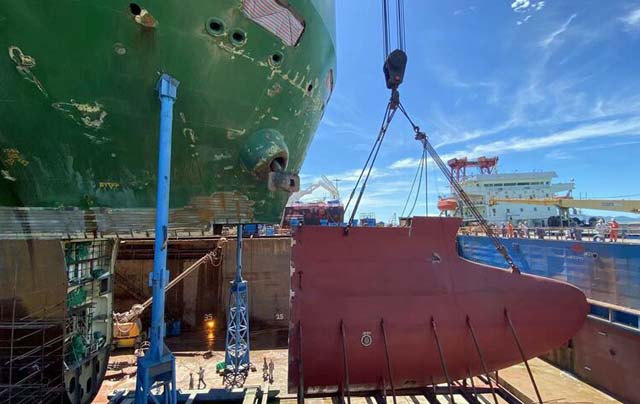
Wallenius Wilhelmsen has unveiled the first upgrade to one of its PCTC vessels as part of the company’s journey to zero emissions, with a new bulbous bow fitted to the ‘Aniara’.
The work was carried out at the IMC-Yongyue (IMC-YY) repair yard in Zhoushan, China, and executed within the anticipated three-week dry-docking span. Three other vessels – Oberon, Tijuca, and Tirranna – await similar enhancements, with pre-fabrication efforts now underway.
Adam Larsson, Senior Manager Energy Efficiency and Performance, said: “The existing bulbous bow design was initially optimised for one very specific draught and speed. However, operational data clearly show that the vessels operate at lower draughts and speeds a significant portion of the time, where the existing design is not performing well, creating additional resistance to move through the water.”
In collaboration with design partners, DSEC & DSME/Hanwha, the team carved out an optimised design that reduces resistance and promises considerable fuel savings. Estimated fuel savings amount to an average of 6%, translating to a reduction of 1,400t of CO2 annually for each vessel.
Larsson added: “We can expect even larger average savings if actual operating speeds are reduced in the future because the new design compared to the old will perform much better at lower speeds. Worth noticing is that at some operating conditions, such as lower draught about 8m and 14 knots speed, the savings can be as much as up to 30%.”
The newly developed 137t, 23m bulbous bow section underwent a two-month pre-fabrication phase, when it was coated and lifted into the dry dock using a large floating crane before installation. The yard carefully planned the operation, which was undertaken with accuracy and efficiency in a limited timeframe.
Lars Ekren, Senior Manager Newbuilding and Projects said: “The most exciting part of the project is during the lifting and installation of the new bulbous bow section as it can never be guaranteed that everything will go as planned. Luckily, the new section matched perfectly well with the existing hull, and the yard managed to finalise the installation in less than a week, which is impressive.”
The project was initiated with a fleet screening, checking suitable retrofit candidates and defining a representative operating profile for optimisation, and then working with design partners to develop and verify the performance of the new bulbous bow design, using CFD simulations and physical scale model tests.
Ekron said: “The two next bulb installations will take place in October for Tijuca and Oberon and the prefabrication work is already completed. We expect these installations to be executed successfully, even though we will naturally be a bit nervous when the installation is to take place.”