
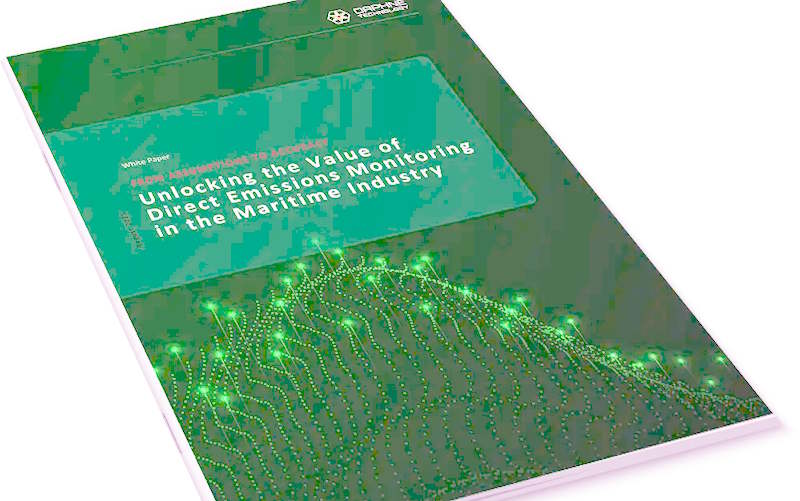
Daphne Technology has released a new white paper: ‘From Assumptions to Accuracy – Unlocking the Value of Direct Emissions Monitoring in the Maritime Industry’ which examines the limitations of estimation-based emissions reporting and explains how direct measurement offers a more accurate, transparent, and future-proof approach.
As regulations tighten under the EU MRV, IMO DCS, and the EU ETS, the quality of emissions data is becoming a financial and operational priority for shipowners and operators. Factor-based methods, while widely used, often leave operators exposed to reporting uncertainty, inflated carbon costs, and underestimation of methane slip.
The white paper sets out how direct measurement, as applied through Daphne Technology’s PureMetrics, addresses these challenges by providing real-world exhaust data that is traceable and audit-ready. Drawing on live deployment experience, it highlights the compliance, cost, and strategic benefits of moving from assumption-based estimates to verifiable measurement. With regulators, verifiers, and charterers all increasing their scrutiny of emissions data, the findings provide insight for decision-makers preparing their fleets for the next phase of compliance and competitiveness.
Jamie Brick, Interim CEO, Daphne Technology, said: “The maritime sector is entering a decisive period where emissions transparency will define both compliance and competitiveness. This white paper reflects the technical progress achieved in collaboration with our partners, and it underlines the importance of moving from assumptions to verifiable data. Direct measurement is not just a technical step forward, it is essential for operators who want to manage costs, reduce uncertainty, and meet the expectations of regulators and stakeholders in the years ahead.”
The publication draws on work by Daphne Technology’s team and industry partners, including real-world deployment of the PureMetrics system on dual-fuel vessels. It combines operational data with analysis of regulatory developments under the EU MRV and IMO DCS frameworks, as well as independent studies on methane slip and greenhouse gas factors.