
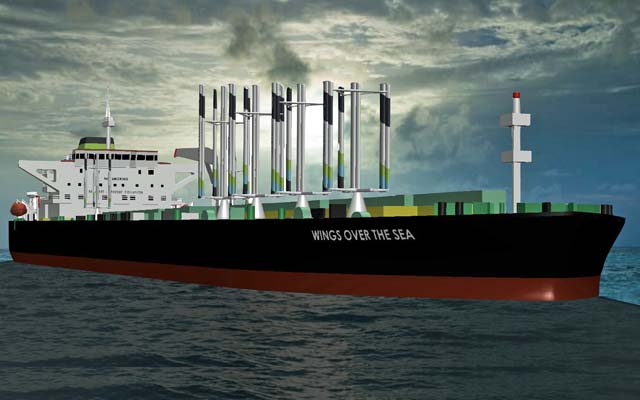
UK maritime engineering company WingTek, in collaboration with the National Composites Centre and the University of Bristol, has won a £2.2m innovation grant from the UK Department for Transport Clean Maritime Demonstration Competition.
The funding, through the Innovate UK initiative, will contribute to further development of the WingTek Wingsail, a Wind Auxiliary Propulsion (WAP) system designed to be retrofitted easily to existing commercial vessels.
WAP complements existing ship propulsion systems; primarily the marine diesel engines burning fossil fuels which power vessels of all types across the global fleet. WAP enables significant reductions in fuel use and therefore harmful emissions from these ships.
WingTek MD Neil Richards said: “WingTek’s innovative Wind Auxiliary Propulsion system has received a significant boost thanks to the help and support of Innovate UK leading to this grant. We are delighted to be working with a fantastic set of project partners at the University of Bristol and the National Composites Centre and we are now well supported to fast-track the development on the route to commercial production.”
The project will deliver two full-size operational prototypes, one on-shore for long-term testing and development and a second unit installed on a commercial UK vessel for sea-trials, with the project scheduled to complete by March 2025.
Richards said: “Think of this as a renewable energy fuel saver for commercial ships. Wind is free and available across the planet and can be harnessed by the world’s existing shipping fleets to reduce its consumption of fossil fuels.”
There are around 55,000 commercial ships in excess of 5,000 tonnes worldwide, burning an estimated 250m tons of fossil fuels annually.
Richards added: “Any reduction in this colossal fuel consumption has immediate benefits. The commercial and environmental value of adding WingTek Wingsails is evident – on routes such as the North Atlantic and the North Sea, the savings can be substantial and rise significantly when used in conjunction with weather routing. We can save ship operators fuel costs and greenhouse gas emissions, whether the ship has a traditional engine burning fossil fuels or one burning newer, but more expensive, clean alternatives. Our wind propulsion systems can be retrofitted to existing vessels, designed into new-builds, and easily removed when decommissioned or re-installed on another vessel in the fleet,” continued Neil.
WingTek Chairman Roger Francis said: “We started with a sea-proven design with a long pedigree which we’ve refined and developed based on our own direct maritime operational experience. The result is a resilient solution developed using state of the art tools, materials and control technologies. Fleet operators are under pressure to reduce their carbon emissions and operating costs by reducing dependence on fossil fuels. The WingTek Wingsail system provides a practical and workable solution for both vessel owners and charter operators”.
Under the grant, project partners The University of Bristol (UoB) and Bristol-based National Composites Centre (NCC) will work with WingTek to deliver the two prototype wingsails. The NCC will contribute its knowledge and expertise in composite design and structural analysis in the development of the two demonstration prototypes.
James Graham, Chief Engineer Surface Transport NCC, said: “The CMDC3 award is an example of how the National Composites Centre is well positioned to support the marine sector realise their Net Zero ambitions. With expertise ranging from digital engineering to state-of-the-art end-of-life solutions, we are on board with support to accelerate the design, manufacture, and operation of UK-made clean maritime technologies.”
The University of Bristol will provide expertise in 2D and 3D computational fluid modelling of aerodynamics, wind tunnel facilities for physical model testing and energy system modelling.
Prof Ann Gaitonde, University of Bristol School of Civil, Aerospace and Design Engineering, said: “We are excited to be part of the WingTek Wings for Ships project. The WingTek Wind Assisted Propulsion technology being developed has the opportunity both to transform the emissions from shipping and allow straightforward adoption by the commercial fleet.”
Image: WingTek WAP on tanker (source: WingTek/IWSA)