
Swiss marine power company WinGD has successfully completed another factory acceptance test (FAT) for its ammonia-fuelled two-stroke marine engine, further advancing the development and commercial readiness of ammonia-fuelled propulsion for zero-carbon shipping.
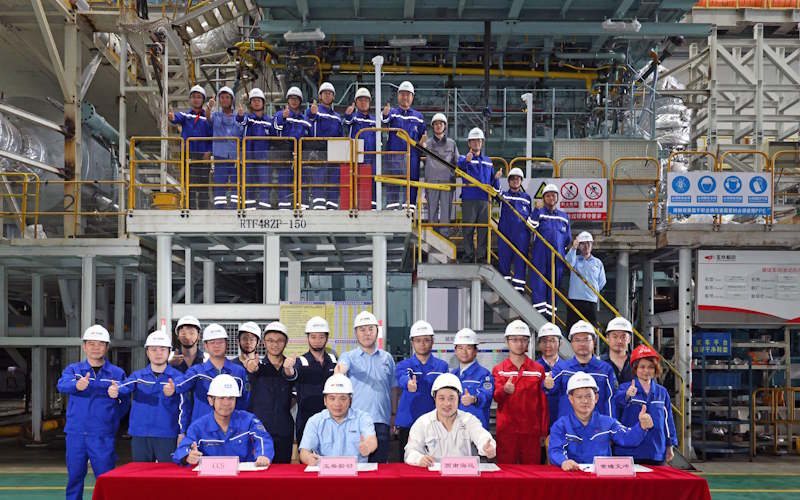
The latest FAT follows the successful completion of both type approval testing (TAT) and the first FAT of WinGD’s ammonia-fuelled engine platform in South Korea earlier in 2026, marking continued progress in the validation and deployment of ammonia propulsion technology. The X52DF-A-1.0 engine, built by Yuchai Marine Power (YCMP) underwent testing in April 2026, in the presence of China Classification Society.
The engine will be installed on the first vessel for Tianjin Southwest Maritime in a series of four LPG/ammonia carriers currently under construction at CSSC Huangpu Wenchong Shipbuilding in China. The project represents a further step in the commercial deployment of ammonia-fuelled two-stroke propulsion for this vessel type, supporting the industry’s transition towards low- and zero-carbon fuels.
Peter Krähenbühl, VP Product Centre, WinGD, said: “The successful completion of factory acceptance testing in China provides further validation of our X-DF-A platform across key performance and safety parameters. The results demonstrate continued progress in the development and validation of ammonia-fuelled engine technology.”
The testing programme, which took place on the 52-bore engine to be installed on a 25,000m³ LPG/ammonia carrier, demonstrated stable engine performance and encouraging emissions results. NOx emissions during ammonia operation were significantly lower than those from conventional fuels, while N₂O emissions remained minimal, contributing to an improved overall GHG profile.
Krähenbühl added: “Bringing ammonia propulsion into commercial service depends on close cooperation across the maritime value chain, particularly between engine designers and engine builders. Working closely with partners such as YCMP allows us to translate development progress into reliable manufacturing and testing outcomes, supporting the safe and efficient deployment of ammonia-fuelled propulsion technologies.”
WINgd says that confidence in ammonia as a future marine fuel continues to grow, as reflected in its orderbook with over 30 X-DF-A engines across multiple vessel segments, including gas and bulk carriers, tankers and container vessels. This momentum highlights the pace of adoption as engine technology, ship design and operational frameworks advance in parallel, with the successful completion of testing further demonstrating the robustness of the programme.
This latest milestone reflects continued global investment in ammonia propulsion technology, with early projects demonstrating its growing viability across key shipping segments. As a scalable, carbon-free fuel, ammonia is thought to be gaining traction as part of the industry’s long-term decarbonisation strategy, supported by parallel developments in fuel production, infrastructure and vessel design. A growing body of studies, including a recent analysis by WinGD and Envision, continues to highlight ammonia’s economic competitiveness and long-term viability as a marine fuel.
The X-DF-A engine platform features high-pressure ammonia injection supplemented by a low, targeted pilot fuel dose of around 5% at full load. It delivers load handling, dynamic response and fuel efficiency comparable to WinGD’s diesel-fuelled X-engines in both ammonia and diesel operating modes, offering shipowners a practical pathway to reduce emissions while maintaining operational flexibility.
Image: The WinGD X52DF-A-1.0 engine, built by YCMP, has completed FAT (source: WinGD)