
According to Swiss engine designer WinGD, shipowners face significant decisions about how to stay competitive and compliant.
The company believes that well-planned and supported retrofit programmes can add many profitable years of compliant operation to the existing fleet – without the newbuild price tag. Shipowners face a difficult reality: most of the vessels that will be trading in 2030, and indeed in 2040, are already at sea today. For those managing existing fleets, the challenge is clear: how to reduce costs, meet tighter environmental regulations and maintain competitiveness before making significant investments in newbuilds?
One answer lies in retrofits and engine upgrades. Upgrading the performance, reliability and fuel capabilities of vessels already in service promises a pragmatic and more immediately cost-effective way to make progress towards decarbonisation.
René Bart, Head of Retrofit Solutions, WinGD, said: “While newbuilds will always attract the headlines, the reality is that the path to net zero runs through the ships already in service. Retrofits give shipowners the flexibility to reduce emissions, improve efficiency and extend the value of their assets today, not years from now.”
The decision to retrofit or upgrade is more than regulatory box-ticking. It is a strategic decision that can deliver fuel savings, optimise lifecycle costs and retain asset value.
Bart continued: “Given the still-emerging regulatory landscape, a retrofit programme can bring some much-needed operational certainty, delivering predictable savings, compliant operations and minimise time off-hire,. With compliance costs increasingly challenging the profitability of older vessels, a well-timed retrofit can also keep a vessel in viable service for longer.”
While new ships can be designed from scratch to meet new emissions rules, existing vessels have legacy design and technology issues that may complicate the conversion to new fuels or efficiency measures. The right investments – or whether to invest at all – will be a ship-by-ship decision that will depend on a number of factors including the vessel’s existing machinery and equipment, its age and operating profile, the availability and cost of new technologies and its drydocking schedule.
Options include:
- Engine conversions for LNG, methanol or ammonia fuel
- Engine and engine control upgrades
- Emissions abatement installations and upgrades
- Engine derating and advanced tunings
- Hybrid power and energy management systems installations
- Digital optimisation solution installations and upgrades
- Reliability upgrade to ensure trouble-free operation
The most visible retrofit pathway is considered to be the conversion of existing diesel engines to operate on cleaner fuels such as LNG, methanol or ammonia. All WinGD X and X-DF engines are designed with this adaptability in mind, making the conversion – including the replacement of cylinder heads, installation of fuel injectors and modification of control systems – relatively straightforward.
Bart said: “Infrastructure and fuel availability are evolving at different speeds around the world. By converting vessels today, shipowners can secure compliance and cost advantages immediately while positioning themselves for future fuel adoption.”
WinGD’s dual-fuel ready diesel X-Engines can be converted to dual fuel when the shipowner makes the decision to opt for a greener fuel, be it LNG, methanol or ammonia. In the case of LNG, the work scope for the engine includes cylinder cover and liner replacement, additional gas admission valves and gas supply piping, and engine control system modifications. The ship itself requires LNG storage tanks and a fuel gas supply system, an inert gas system and additional control, safety and alarm systems. Additional updates to the X-DF engine, such as intelligent control by exhaust recycling (iCER) and variable compression ratio (VCR) technology, will further enhance the emissions savings . An additional filler gasket alone, placed between cylinder cover and cylinder liner, can reduce methane slip by 0.2g/kWh for just two to four days of installation work.
Not every vessel is a candidate for fuel conversion, but there are still other retrofit pathways to reduce energy intensity and improve competitiveness.
Automated Sequential Turbocharging (aSTC) allows operators to cut fuel consumption at partial loads, saving up to 5g/kWh. Engine derating and advanced diesel tuning can deliver measurable efficiency gains while improving EEXI and CII ratings. Intelligent Combustion Control automatically adapts injection and valve timing to compensate for changing ambient conditions, reducing fuel burn and wear on engine parts.
Digitalisation plays a vital role. WinGD’s WiDE platform provides real-time diagnostics, troubleshooting, predictive maintenance and performance optimisation, helping crews and operators make informed decisions that extend engine life and cut operating costs.
A successful retrofit requires the right partner. WinGD, for example, has a global service network that ensures expert guidance, rapid support and genuine parts availability wherever ships operate, reducing project risk and minimising downtime. For shipowners, this means every upgrade – from a simple software update to a full dual-fuel conversion – comes with the reliability of the OEM and the support of a long-term partner. There is not infinite capacity, however, and there’s bound to be a scrabble for capacity as compliance deadlines loom.
Bart concluded: “Shipowners who act early not only gain the compliance and emissions benefits, but they also reduce operating costs and secure long-term value from their assets. Retrofits are not just a stop-gap – they are the commercially sensible and proven bridge to a compliant and sustainable future.”
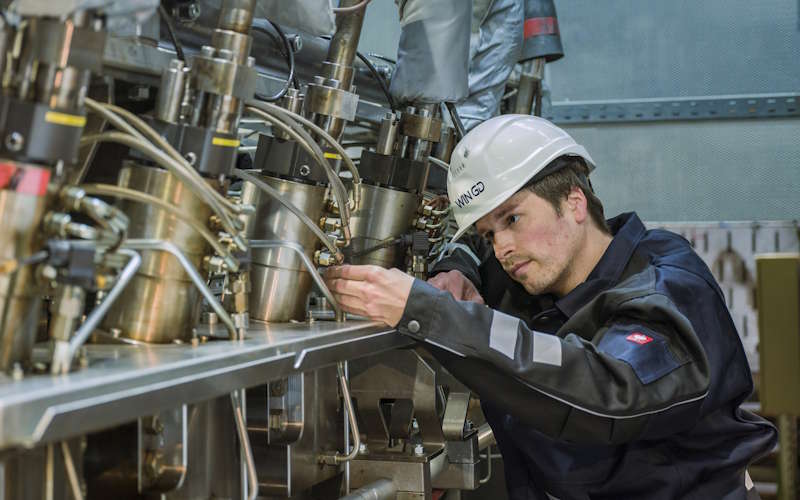
Image: WinGD suggests that a well-planned retrofit programme can ensure future compliance (source: WinGD)